
Introduction: A Rare Visitor from the Stars
In July 2025, astronomers around the world were electrified by the discovery of a new cosmic visitor: 3I/ATLAS. This object isn’t just another comet; it carries the rare designation “3I,” marking it as only the third confirmed interstellar object ever observed passing through our Solar System. (Wikipedia)
With an interstellar origin, a hyperbolic trajectory, and peculiar physical and chemical traits, 3I/ATLAS has already rewritten some of our assumptions about comets — and promises to reveal secrets about planetary systems beyond our own. Here’s everything you need to know about this extraordinary cosmic wanderer.
Discovery & Confirmation: How 3I/ATLAS Was Found
- First spotted on 1 July 2025 by the ATLAS survey telescope at Río Hurtado, Chile. At the time of discovery, it was already on its inward journey, roughly 3.50 AU from Earth. (Wikipedia)
- The object was initially catalogued as A11pl3Z. But its unusual motion — far too fast, and on a trajectory unlike any bound Solar System object — caught astronomers’ attention. Soon, pre-discovery images from June (and even earlier) were located in survey archives, helping trace its path. (Wikipedia)
- Follow-up observations from a dozen observatories confirmed the early suspicion: this object follows a hyperbolic orbit, meaning it is not gravitationally bound to the Sun and originated from beyond. The designation “3I” — third interstellar object — was officially adopted. (Wikipedia)
Thus, 3I/ATLAS is the successor to 1I/ʻOumuamua (2017) and 2I/Borisov (2019), joining their exclusive club of confirmed interstellar visitors. (Planetary Society)
Orbit & Trajectory: A Path from the Depths of Space
- 3I/ATLAS enters the Solar System on a steep, hyperbolic trajectory, which means it is simply passing through. It will not orbit the Sun — or Earth — permanently. (Wikipedia)
- Its closest approach to the Sun (perihelion) occurs in late October 2025, at around 1.4 astronomical units (AU) — just inside the orbit of Mars. (NASA Science)
- As for Earth: 3I/ATLAS will not come dangerously close. The minimum separation is about 1.8 AU (≈ 170 million miles / 270 million kilometers) — so there’s no threat of collision. (NASA Science)
- Its journey through the Solar System is rapid: the high inbound and outbound speed, combined with the gravitational slingshot effect of the Sun, ensures 3I/ATLAS will continue onward, never to return. (Wikipedia)
This hyperbolic path is strong, nearly definitive evidence that the object came from interstellar — that is, outside our Solar System — space. (Planetary Society)
Physical Properties: What We Know (—and What’s Still a Mystery)
Comet, not asteroid
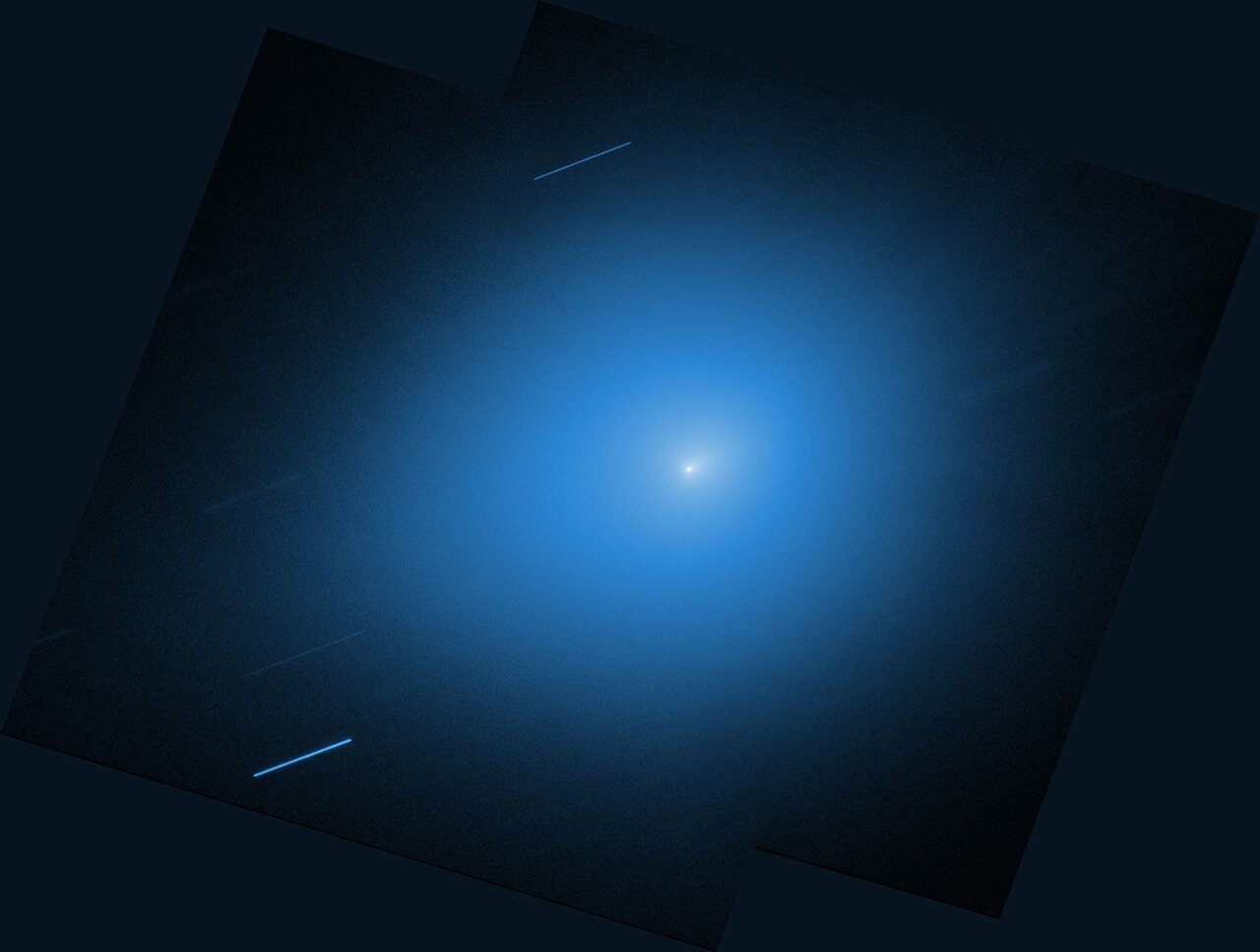
Shortly after discovery, several observatories detected a faint coma — a cloud of gas and dust — surrounding the nucleus of 3I/ATLAS. That, along with some subtle elongation suggestive of a tail, immediately classified the object as a comet, not an asteroid. (Wikipedia)
In that sense, 3I/ATLAS resembles its immediate predecessor, 2I/Borisov, which was also cometary. (Planetary Society)
Size estimates — uncertain but notable
Because the coma contributes significant light, separating the brightness of the nucleus alone is difficult, so size estimates remain uncertain. Based on observations so far, astronomers estimate the nucleus of 3I/ATLAS to be between 440 meters (≈1,400 ft) and 5.6 kilometers (≈3.5 miles) in diameter. (NASA Science)
If the larger end of that estimate proves accurate, 3I/ATLAS could be the largest interstellar comet observed so far, making its visit even more remarkable. (Planetary Society)
Chemistry: A coma rich in CO₂ (and more)
One of the most remarkable—and intriguing—findings comes from spectroscopic observations by the James Webb Space Telescope (JWST). In August 2025, JWST’s near-infrared spectroscopy revealed that 3I/ATLAS’s coma is dominated by carbon dioxide (CO₂), with substantial—but comparatively small—amounts of water ice, water vapor, carbon monoxide (CO), and carbonyl sulfide (OCS). (arXiv)
Specifically, the ratio of CO₂ to H₂O in the coma is among the highest ever recorded for any comet — solar system or interstellar. This suggests 3I/ATLAS may come from a planetary system where icy bodies formed under different conditions (e.g., a region of its protoplanetary disk where CO₂ ices froze out). (arXiv)
Because of the high CO₂ and relatively low water production, some scientists speculate that the comet’s nucleus may have formed under more intense radiation — or at farther distances — than typical comets in our Solar System. (NASA Science Center)
Polarimetric behaviour — unlike anything seen before
Polarimetric studies — measuring how 3I/ATLAS reflects and polarizes light — have revealed truly distinctive traits. Observations using the Very Large Telescope (VLT) and other facilities show a deep and narrow negative polarization branch, with a minimum polarization of about –2.7% at a small phase angle (7°), and an inversion angle near 17°. (arXiv)
What does that mean? The combination of polarization behaviour, coma presence, and observed spectral colours suggests that 3I/ATLAS may represent a different type of comet — one unlike any previously catalogued in our Solar System. Perhaps, a member of a broader family of icy bodies formed in other star systems. (arXiv)
Why 3I/ATLAS Matters: Science, History, and Cosmic Perspective
A new window into alien planetary systems
Every comet within our Solar System formed from the same cloud that created the Sun and planets. By contrast, 3I/ATLAS formed elsewhere — possibly around a completely different star, in a different protoplanetary disk, under different conditions. Studying it gives us a rare—and possibly once-in-a-lifetime—opportunity to peer directly into the chemical and physical processes that operate in far-off planetary systems.
The unusual CO₂-rich composition, for example, may tell us about where and how icy planetesimals form around other stars — shedding light on planet formation, the distribution of volatile compounds, and the potential habitability of exoplanets.
Expanding the diversity of known comets
The polarimetric and compositional peculiarities of 3I/ATLAS demonstrate that comets aren’t a monolithic class of objects. Instead, they vary — sometimes widely — depending on where they formed. This helps astronomers refine models of comet formation, migration, and ejection across different star systems.
Testing our models of the Milky Way’s “interstellar inventory”
The orbit of 3I/ATLAS suggests it may have come from a population of ancient stars belonging to the Galaxy’s “thick disk” — a region of old, slowly-rotating stars above and below the main Galactic plane. Some estimates suggest that 3I/ATLAS might be over 7 billion years old, making it far older than our Solar System. (Phys.org)
If the birthplaces and ejection mechanisms for objects like 3I/ATLAS are relatively common, it could imply that our Solar System is constantly traversed by icy wanderers — a dynamic, interconnected Galactic ecosystem of drifting planetesimals.
Pushing planetary defense and observation capabilities
The detection of 3I/ATLAS underscores the importance of sky-survey instruments like the ATLAS telescope network, and the need for powerful follow-up assets such as JWST and ground-based observatories. Each new interstellar visitor challenges astronomers to refine detection algorithms, prepare observational campaigns rapidly, and perhaps — one day — even plan interception missions.
Open Questions & What Scientists Are Watching For
Despite the wealth of data already collected on 3I/ATLAS, many mysteries remain. Here are some of the major questions:
- Exact size and mass: Because the coma contributes a lot of the observed light, estimates of the nucleus size remain uncertain. Is it closer to 0.5 km, or several kilometers across? The difference affects our understanding of its composition and origin.
- Origin star system: Tracing the motion of 3I/ATLAS backward in time through the Galaxy is challenging; so far, no convincing candidate star has been identified as its birthplace. (arXiv)
- Formation conditions: The high CO₂ content suggests unusual formation conditions — perhaps a cold protoplanetary disk or a location far from its host star. More data is needed to confirm such scenarios.
- Long-term fate: 3I/ATLAS is now outbound; by early 2026 it will likely be beyond reach. Can astronomers wring all possible science out of a single brief encounter? Or will we only scratch the surface?
- Population statistics: Was 3I/ATLAS a fluke? Or is there a vast population of interstellar comets passing through the Solar System — most of them too small or faint for current surveys to catch?
What Observers & Enthusiasts Should Know
- 3I/ATLAS is not a threat: Its closest approach to Earth is about 1.8 AU, far enough to pose zero collision risk. (NASA Science)
- Not visible to the unaided eye: Its brightness — even at peak — was not expected to exceed about magnitude 11.5, making it quite faint for casual stargazing. Binoculars or modest telescopes are needed even at peak visible brightness. (Wikipedia)
- Already receding: By late 2025 and early 2026, the object will be moving away from the Sun and Earth, slowing the window for observations. The best chance to study its tail, nucleus, and outgassing behaviour may soon be gone.
- Scientific value far outweighs the inconvenience: Despite its faintness and brief visibility, 3I/ATLAS offers a unique chance to study material from a completely different star system. For professional astronomers — and even dedicated amateurs — this is a once-in-a-lifetime opportunity.
The Big Picture: Why 3I/ATLAS Changes Our View of the Cosmos
In a real sense, 3I/ATLAS confirms that our Solar System is not isolated. It is embedded in a broader Galactic context — a dynamic, interstellar neighborhood where objects drift between stars, where icy bodies formed light-years away can wander in and visit, and where each such visitor carries clues about alien planetary systems.
By studying 3I/ATLAS, astronomers glean insights about the richness and variety of planetary system formation across the Galaxy. Its unusual chemistry and physical traits challenge long-held assumptions. Its path suggests that interstellar visitors may be more common than we thought — we just lack the detection power to catch them all.
Whether 3I/ATLAS is common or rare — and whether future visitors will be stranger yet — remains to be seen. But one thing is clear: this third interstellar object has already expanded our understanding of how diverse the cosmos can be.
Conclusion
3I/ATLAS is not just another comet — it is a messenger from beyond the Solar System, carrying with it ancient history, alien chemistry, and cosmic mystery. From its discovery in July 2025 by the ATLAS telescope, to the detailed observations by JWST and ground facilities, it has given scientists and the public a rare glimpse into the interstellar environment.
Though its visit is brief and its presence faint, 3I/ATLAS’s importance looms large. By studying it, we broaden our understanding of the Galaxy’s formation history, the diversity of planetary systems, and the kinds of objects that silently wander between stars.
As we improve our detection capabilities and open our eyes wider to the cosmos, we may well find that 3I/ATLAS was not a curiosity — but the first of many interstellar visitors yet to be discovered.
