
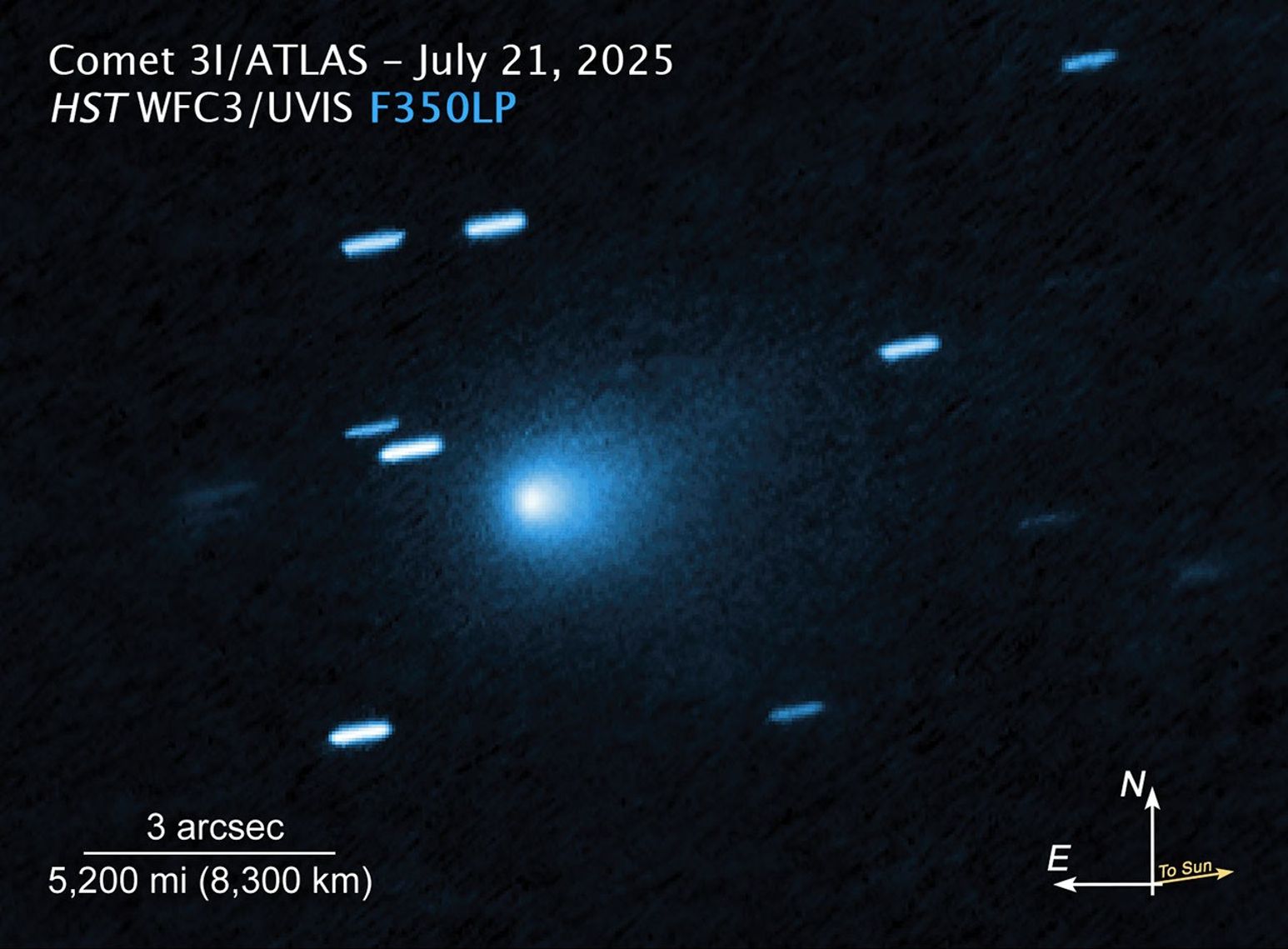
Introduction: A Visitor From Beyond
In July 2025, astronomers operating the survey telescope network ATLAS in Chile detected a faint, fast-moving object already on its way into our Solar System. Initially catalogued as A11pl3Z, further observations revealed something extraordinary: the object followed a hyperbolic orbit and was moving much too fast to be gravitationally bound to the Sun. It soon earned the name 3I/ATLAS, marking it as the third known interstellar visitor after 1I/ʻOumuamua (2017) and 2I/Borisov (2019). (Wikipedia)
For scientists and sky watchers alike, 3I/ATLAS represents a once-in-a-generation opportunity. Here is an object that formed around a completely different star — perhaps billions of years ago — now drifting through the Solar System and carrying the chemical and physical signatures of its long-lost home. In this article, we explore its origin, its strange journey, what makes it unique, and why it matters for our understanding of the cosmos.
1. Discovery & Confirmation: How We Know It’s Interstellar
The discovery of 3I/ATLAS was made on 1 July 2025, when ATLAS telescope spotted a dim, moving point of light approximately 670 million kilometers from the Sun — roughly within Jupiter’s orbit. (Wikipedia)
What set this object apart immediately were its kinematics and trajectory:
- Speed: It was moving at about 61 km/s relative to the Sun — far faster than typical Solar System comets. (3I/ATLAS Tracker)
- Orbit Shape: Rather than following an elliptical path around the Sun, 3I/ATLAS is on a hyperbolic orbit. In celestial mechanics, this means the object is unbound — a one-time visitor that will pass through and leave, never to return. (NASA Science)
- Precovery Observations: After the initial report, astronomers found earlier observations — including data from the Zwicky Transient Facility (ZTF) dating back to mid-June 2025 — confirming the inbound path and interstellar origin. (Wikipedia)
Because of these hallmarks, the Minor Planet Center (MPC) and other astronomical bodies officially recognized it as an interstellar object, giving it the prefix “3I”. (Wikipedia)
Compared to its predecessors — ‘Oumuamua and Borisov — 3I/ATLAS also encountered significant media attention because it arrived at a time when telescopic and spectroscopic technology has advanced considerably.
2. The Long, Long Journey: Where Could 3I/ATLAS Have Come From?
One of the most tantalizing aspects of 3I/ATLAS is its origin story — or rather, the lack of a definitive one. Because it has been traveling in interstellar space for potentially billions of years, its original parent star is effectively lost to time. (Wikipedia)
Some key points scientists have inferred so far:
- Based on its motion and composition, 3I/ATLAS may have formed around a low-metallicity star in the old “thick disk” of the Milky Way, perhaps 7–14 billion years ago — making it significantly older than our Solar System. (Wikipedia)
- Composition analyses suggest it formed far from its parent star, beyond the “frost line” — that is, the region where volatile ices like carbon dioxide (CO₂) and water ice can condense. (Wikipedia)
- Over its cosmic journey, 3I/ATLAS may have endured close encounters with stars, nebulae, or other gravitational influences — perhaps altering its motion or mixing in new materials — before finally drifting into our Solar System. (Wikipedia)
In short: 3I/ATLAS may carry within it a record of planetesimal formation in far-away, ancient planetary systems — a unique surviving relic of deep cosmological history.
3. What We Know About Its Composition: Icy, Metal-Bearing, and Pristine
Once astronomers identified 3I/ATLAS as interstellar, the focus quickly shifted to understanding what it’s made of. Several recent studies have begun to characterize its chemistry and physical structure — with surprising results.
❄️ A CO₂-Rich Coma & Unexpected Water
Using the infrared instruments of the James Webb Space Telescope (JWST), researchers found that 3I/ATLAS’ coma — the hazy envelope of gas and dust around the nucleus — is dominated by carbon dioxide (CO₂). Other volatile compounds detected include water (H₂O), CO, and OCS (carbonyl sulfide), along with water ice and dust grains. The ratio of CO₂ to H₂O is among the highest ever measured in a comet’s coma. (arXiv)
This is notable because, in typical Solar System comets, water ice tends to dominate as they near the Sun. The prevalence of CO₂ suggests 3I/ATLAS formed in a very cold environment — far from its parent star — and that its volatile inventory reflects those frigid birth conditions. (arXiv)
Yet, water is present, too: ultraviolet observations by the Neil Gehrels Swift Observatory recorded OH emission — a byproduct of water sublimation — as early as July 2025, when the comet was still well beyond the orbit of Mars. The inferred water production rate was ~1.35 × 10²⁷ molecules/second (about 40 kg/s), which is unusual for such heliocentric distances. (arXiv)
🪨 Carbonaceous, Metal-Bearing, and — Perhaps — Pristine
A separate spectrophotometric study compared 3I/ATLAS to carbonaceous chondrite meteorites found on Earth. The results suggest the comet may be metal-bearing — containing native metals — and composed of primitive carbonaceous material. Some hypotheses even propose that its nucleus may have undergone aqueous alteration (chemical reactions involving water) during its journey, possibly forming complex minerals. (arXiv)
This combination — water ice, carbonaceous compounds, CO₂ dominance, metal content — paints a picture of a comet that is likely a “time capsule” from a distant, ancient planetary system — perhaps unlike any comet we’ve studied before.
4. Unusual Behavior & Theories: Comet — or Something More?
While 3I/ATLAS exhibits many characteristics consistent with Solar System comets — icy nucleus, coma, outgassing, hyperbolic trajectory — some of its behaviors have sparked debate, excitement, and even speculation about more exotic origins.
🌋 Cryovolcanism and Coma Morphology
Observations in late 2025 suggest 3I/ATLAS may be experiencing cryovolcanism — eruptions of gas and dust (driven by sublimation of ices) from its surface or subsurface. The outgassing jets, particularly rich in CO₂, appear to create asymmetric coma and tail structures, perhaps akin to those seen in icy trans-Neptunian objects, rather than typical comets from the Solar System. (Live Science)
Moreover, polarimetric studies (measuring how sunlight reflects off the surface) found that 3I/ATLAS has a deep and narrow negative polarization branch — a combination never before seen in asteroids or comets. This polarimetric “signature” more closely resembles that of some small, icy bodies in the outer Solar System (like Centaurs or trans-Neptunian objects), suggesting 3I/ATLAS may represent a new type of comet. (arXiv)
💡 “Heartbeat” Pulses and Alien Speculation
One of the most sensational — and controversial — aspects of 3I/ATLAS are claims by prominent scientist Avi Loeb (and others) that the comet is exhibiting a 16.16-hour periodic “pulse” in brightness — a rhythmic flicker likened to a “heartbeat.” Some interpret this as possible evidence of artificial activity, prompting speculation that 3I/ATLAS could be an alien probe rather than a natural comet. (The Times of India)
Still, mainstream astronomers remain skeptical. According to NASA, all available evidence points toward 3I/ATLAS being a natural comet. Its outgassing behavior, coma structure, and tail formation match known comet phenomena, and no definitive “technosignatures” have been observed. (Space)
💫 A Paradigm Shift in Interstellar Object Understanding
Recent research suggests that due to billions of years traveling unprotected through interstellar space, 3I/ATLAS might have developed an irradiated crust — up to 15–20 meters deep — formed by galactic cosmic rays. This crust may have altered its surface chemistry and appearance, meaning the material we currently observe may not fully represent its original composition. Such a finding has major implications for how we interpret interstellar comets: they may not be pristine relics, but rather processed, aged, and chemically transformed by their long voyage. (Live Science)
If confirmed, this challenges long-held assumptions about what interstellar visitors can tell us about their home systems — but also opens a new window into how such objects evolve over cosmic time.
5. What 3I/ATLAS Means for Astronomy — And for Us
The arrival of 3I/ATLAS is more than just a curiosity; it could be a game-changer for our understanding of the galaxy. Here’s why:
- Diversity of planetary systems: By analyzing 3I/ATLAS, scientists can compare its composition and structure with Solar System comets — offering direct evidence of how planetesimal formation may differ in other star systems.
- Interstellar material exchange: If interstellar comets like 3I/ATLAS are common, it implies material — including potentially organic or prebiotic compounds — may travel between star systems, seeding planetary systems with raw building blocks.
- Evolution over cosmic time: The possibility that 3I/ATLAS has developed an irradiated crust expands our view of how small bodies evolve over billions of years in the harsh environment of interstellar space.
- Testing comet theories: Outgassing, cryovolcanism, coma chemistry, and polarimetric anomalies observed on 3I/ATLAS challenge current comet models — forcing astronomers to refine or expand theories of comet behavior.
- Public fascination and scientific humility: The mix of rigorous data and speculative, even provocative, theories (like artificial origin) captures public imagination — but also underscores the humility and uncertainty inherent in frontier science.
In short, 3I/ATLAS may serve as a bridge connecting our Solar System to the broader galactic neighborhood — a traveler bringing stories from distant suns and carrying lessons about cosmic history.
6. Observing 3I/ATLAS — What We Can (and Can’t) See From Earth
For sky watchers, amateur astronomers, and scientifically curious readers, 3I/ATLAS presents a visible target — albeit a faint one. According to NASA:
- It poses no threat to Earth. Even at its closest approach, it will remain about 1.8 astronomical units (≈ 270 million km) away from us. (NASA Science)
- Its brightest expected magnitude is around 11.5 — too faint for the naked eye, but within reach of moderate telescopes or good binoculars under dark skies. (Wikipedia)
- During its 2025 passage, it became observable again from the ground after passing behind the Sun, and it may remain visible into early 2026. (NASA Science)
For those interested, follow-up observations from major observatories — and even citizen astronomers — remain essential. Each new dataset helps refine our understanding of the comet’s orbit, composition, and behavior.
7. Why “From Interstellar Space to Solar System” Matters — The Big Picture
The journey of 3I/ATLAS isn’t just a cosmic novelty; it’s a story that combines deep time, galactic motion, and the physics of icy bodies. It stands at the intersection of:
- Astrophysics: Revealing how objects can be ejected from one star system and travel across the galaxy for billions of years.
- Planetary science: Offering a unique data point about how small bodies form and evolve in vastly different environments than our Solar System.
- Astrobiology: Because 3I/ATLAS carries volatiles and carbon-rich compounds, it hints at the distribution of life’s raw materials beyond our home system.
- Cosmic archaeology: As a potential relic of an ancient planetary system, 3I/ATLAS may embody a record of processes from an era long before Earth even existed.
In the coming months and years, studies of 3I/ATLAS — along with potential future interstellar visitors — could reshape how we see our place in the cosmos: not as a lone system, but as one of countless planetary neighborhoods exchanging matter over billions of years.
Conclusion
3I/ATLAS is far more than “just another comet.” It is a messenger from the depths of space — a relic from an ancient star system, voyaging across the Milky Way, now passing through our own celestial backyard. Its unique chemistry, its hyperbolic trajectory, its odd behaviors and exotic composition make it one of the most important cosmic discoveries of the 21st century.
Whether it ends up reinforcing our current models of cometary science — or forcing us to rewrite them — 3I/ATLAS reminds us that the universe remains full of surprises. Each new object from interstellar space could challenge what we know, expand our horizons, and bring pieces of distant cosmic history into our observational grasp.
As we continue to watch, observe, and analyze, 3I/ATLAS invites us to look up — and wonder.
