
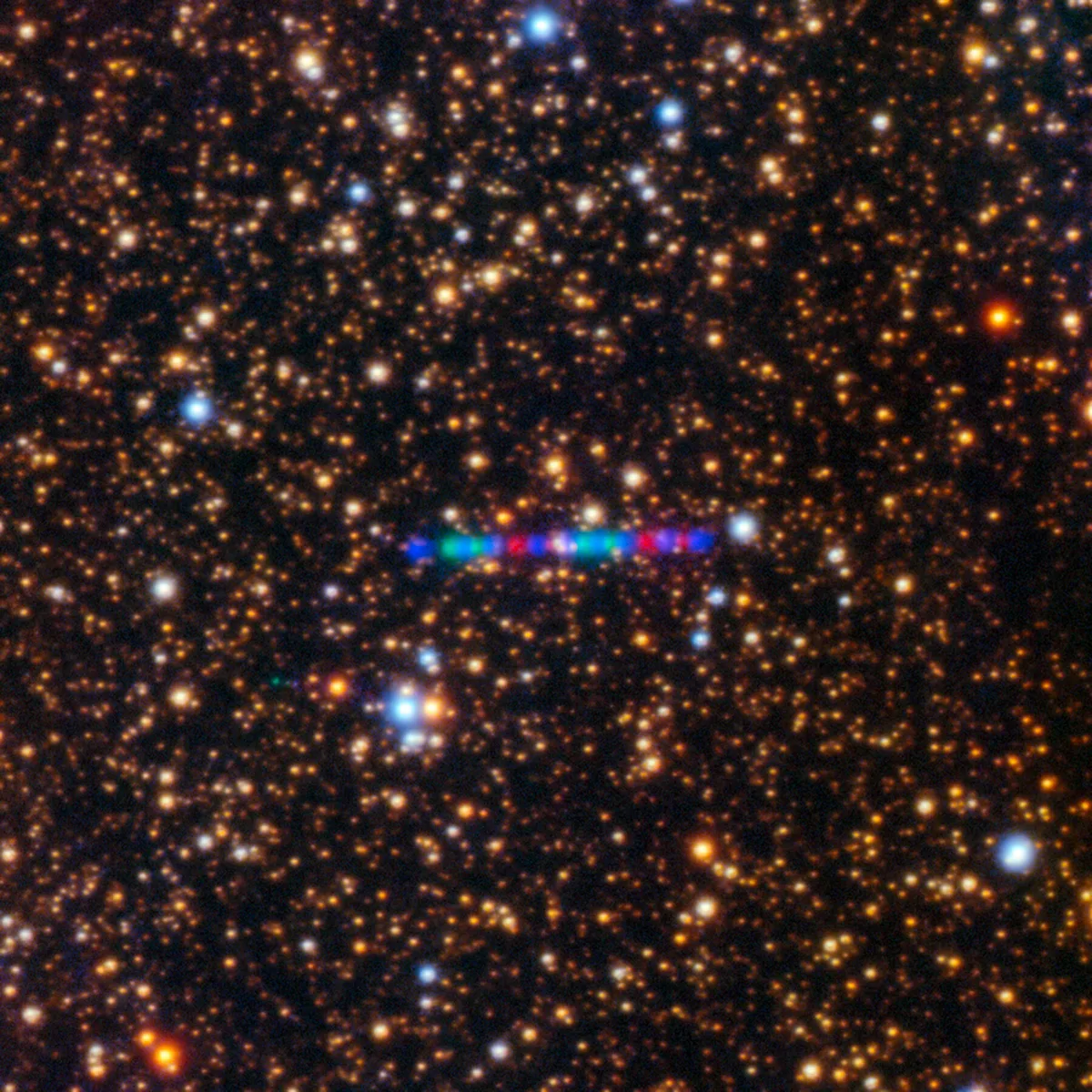
A Visitor from the Stars
In July 2025, astronomers made a discovery that captivated the world: a comet entering our Solar System not from within, but from deep space — from another star system altogether. Named 3I/ATLAS, this interstellar comet is only the third such object ever confirmed. What makes it extraordinary is not just its alien origin, but growing evidence that it may be billions of years older than our own Solar System. From its hyperbolic trajectory to its unusual chemical composition, 3I/ATLAS challenges everything we thought we knew about comets, their origins, and the early history of our galaxy.
In this article we explore why scientists believe 3I/ATLAS could be the oldest comet ever observed, what that means for astronomy, and why this cosmic wanderer is rewriting the story of interstellar objects.
What is 3I/ATLAS — and Why It Matters
A Rare Interstellar Visitor
- 3I/ATLAS was discovered on 1 July 2025 by the ATLAS survey telescope in Chile — part of NASA’s network devoted to tracking near-Earth objects. (NASA Science)
- It is designated “3I” because it is only the third confirmed interstellar object to pass through our Solar System — after 1I/ʻOumuamua (2017) and 2I/Borisov (2019). (Wikipedia)
- The orbit of 3I/ATLAS is hyperbolic, meaning it is not gravitationally bound to the Sun — it is simply passing through, much like a cosmic interstellar guest. (NASA Science)
A Comet — Not an Asteroid or Rock
Unlike ʻOumuamua, which behaved unusually and left scientists puzzled, 3I/ATLAS displays clear comet-like activity: as it approaches the Sun, ices on its surface sublimate, creating a diffuse “coma” of gas and dust, and forming a tail. (National Geographic)
According to observations, the comet’s nucleus size lies between 0.32 km and 5.6 km — roughly up to 3.5 miles wide. (Wikipedia)
Because of its peculiar origin — from beyond our Solar System — 3I/ATLAS provides a once-in-a-lifetime opportunity to study material formed around other stars, offering insights into the formation of planetary systems elsewhere in the Milky Way. (Encyclopedia Britannica)
Why 3I/ATLAS Could Be the Oldest Comet Ever
Origins in the Galactic “Thick Disk”
Researchers analyzing the motion and trajectory of 3I/ATLAS found that its path aligns with a region of the Milky Way known as the galactic thick disk — a population of stars that are much older and lower in heavy elements than stars like our Sun. (Phys.org)
According to a study presented by astronomer Matthew Hopkins (University of Oxford) in 2025, there is a 68% probability that 3I/ATLAS formed in this ancient stellar region — implying an age of 7.6 to 14 billion years. (Forbes)
If this is true, 3I/ATLAS would predate our Solar System (about 4.6 billion years old) by several billions of years — making it potentially the oldest comet ever observed. (Encyclopedia Britannica)
Ancient Ices and Primitive Materials
Spectroscopic observations — including data from the James Webb Space Telescope (JWST) and ground-based telescopes — reveal that 3I/ATLAS is rich in carbon dioxide (CO₂), water ice, dust, and organic materials. (arXiv)
In fact, the CO₂-to-H₂O ratio in its coma is unusually high — among the highest ever recorded — which suggests that 3I/ATLAS formed under conditions very different from the comets in our Solar System, possibly near the CO₂ ice line in its parent system’s protoplanetary disk. (arXiv)
Complementary spectrophotometric studies also point to a metal-bearing and carbon-rich nucleus, akin to primitive carbonaceous meteorites. This suggests 3I/ATLAS represents pristine, early-generation material — offering a chemical “time capsule” from another era of the Milky Way. (arXiv)
Evidence of Galactic Radiation Processing
Because 3I/ATLAS has likely wandered through interstellar space for billions of years, its outer layers are believed to have been processed by cosmic rays. Recent polarimetry and spectroscopy indicate that the comet’s composition — enriched in CO₂, CO, and with red spectral slopes — is consistent with galactic cosmic-ray (GCR) irradiation, which over time can chemically alter surface ices and create organic-rich crusts. (arXiv)
These findings suggest that we are not just witnessing a typical comet — but a unique remnant from a distant, ancient planetary system, preserved over eons and shaped by the harsh environment of interstellar space.
What 3I/ATLAS Tells Us About the Galaxy — and Ourselves
Window into Alien Planetary Systems
Because 3I/ATLAS likely formed around a star other than our Sun, studying it gives scientists a rare chance to sample material from another protoplanetary disk. Its chemical makeup — with high CO₂, carbon-rich dust, water ice, and possibly metal-bearing compounds — offers clues about how planets and comets form elsewhere, how volatile materials are distributed, and how planetary systems can differ dramatically from ours.
This could reshape our understanding of planet formation, especially in older, metal-poor star systems belonging to the Milky Way’s thick disk.
Galactic Archaeology: Comets as Cosmic Fossils
Because of its great age, 3I/ATLAS acts like a fossil of galactic history. It potentially preserves the chemical and physical conditions of a protoplanetary disk from billions of years ago — perhaps from the early epochs of the Milky Way itself.
Studying such objects could help astronomers reconstruct the formation history of the galaxy, understand the evolution of cometary bodies across billions of years, and re-evaluate the diversity and distribution of planetary building blocks across cosmic time.
Challenging Our Assumptions
Before 3I/ATLAS, most known comets originated within our Solar System and were at most ~4.5 billion years old. But this discovery shows that comets can survive — largely unchanged — for billions of years, traversing the galaxy until they intersect a star system.
That widens the scope of what we consider “comet history,” showing that some comets may be far older and far more exotic than previously believed. It compels astronomers to re-think assumptions about comet formation, composition, and longevity.
What Remains a Mystery & Why It Matters
Despite the remarkable findings, many questions about 3I/ATLAS remain unanswered.
- Exact age uncertainty. While estimates place its age between 7.6 and 14 billion years, there is still uncertainty because we cannot trace it back to a specific parent star. Over such vast timescales, interactions with other stars and gravitational perturbations make precise origin tracing very difficult. (Wikipedia)
- How typical is it? Is 3I/ATLAS a rare relic — or are there many more ancient interstellar comets out there, just waiting to be discovered? The discovery suggests that interstellar objects may be more common than we realized.
- Evolution during interstellar travel. How have cosmic radiation, temperature extremes, and collisions with interstellar dust shaped 3I/ATLAS over billions of years? Studies suggest that its outer layers bear the imprint of galactic cosmic-ray irradiation. (arXiv)
- What lies beneath? The material we observe — CO₂, water ice, dust — may only reflect processed surface layers. Whether its interior remains pristine, and what that might reveal, remains an open question.
These uncertainties make 3I/ATLAS more than a curiosity — they make it a scientific treasure trove, with the potential to reshape our understanding of how planetary systems evolve across cosmic time and space.
The Broader Significance — For Astronomy, Planetary Science, and Humanity
Expanding the Definition of “Comet”
For centuries, comets have been studied as relics left over from the birth of our own Solar System. 3I/ATLAS challenges that narrow view. It shows comets can be cosmic travelers, born around different stars long before our Sun existed — and still survive to visit us.
This demands a broader, more inclusive definition of cometary origins and evolution — one that spans not just one star system but the entire galaxy.
Clues to Life’s Building Blocks Across the Galaxy
Because 3I/ATLAS carries water ice, carbon-rich materials, and volatile gases, it acts as a messenger from another star system, carrying within it the raw ingredients that — under the right conditions — might seed planets with volatiles, organics, or even prebiotic molecules.
Understanding such interstellar comets can help answer fundamental questions: How widespread are water and organics in our galaxy? Could they seed habitable worlds? Are planetary systems inherently similar, or wildly diverse in their chemistry?
A New Frontier in Galactic Archaeology
3I/ATLAS is not just a comet — it is a time capsule. By studying it, astronomers can peer back billions of years, to a time when the galaxy was younger, star formation was different, and planetary systems formed under distinct chemical conditions.
This is galactic archaeology: using ancient objects to reconstruct the Milky Way’s history, trace the origins of star populations, and understand the chemical evolution of the galaxy over cosmic time.
Why 3I/ATLAS Deserves to Be Called the “Oldest Comet Ever Seen”
Summarizing the evidence:
- Its orbit comes from interstellar space, likely from the thick disk of the Milky Way — a population of stars known to be ancient. (Wikipedia)
- Statistical modeling suggests a 7.6–14 billion-year age for 3I/ATLAS, with 68% confidence under certain assumptions. (Forbes)
- Composition and spectroscopic data show materials (CO₂, water ice, organics, metals) that are extremely primitive and possibly unaltered for eons. (arXiv)
- Evidence of long-term cosmic-ray processing supports the idea that this comet has been drifting through interstellar space for billions of years. (arXiv)
Taken together, these lines of evidence make a compelling — though not yet definitive — case that 3I/ATLAS is the oldest comet humanity has ever detected.
What to Watch Next: The Future of Interstellar Comet Research
- Continued observations — As 3I/ATLAS moves away from the Sun, astronomers worldwide are tracking its tail, coma, spectral emissions, and outgassing behavior. New data could reveal more about its composition, interior, and any changes post-perihelion.
- Search for more interstellar comets — 3I/ATLAS may not be unique. With more powerful surveys and telescopes (optical, infrared, radio), scientists hope to catch more interstellar visitors — perhaps even older or more exotic.
- Modelling cosmic ray & interstellar exposure effects — Researchers will continue refining models of how long interstellar objects can remain intact, how their surfaces evolve, and what that tells us about the survival of primitive material over billions of years.
- Comparisons with solar system comets — By comparing 3I/ATLAS with known comets from our own system (Oort Cloud, Kuiper belt, etc.), scientists can better understand the diversity of comet-forming environments and test theories of planet formation and comet origins.
A Cosmic Messenger from the Galactic Past
3I/ATLAS is not just another comet — it is a cosmic messenger. Possibly forged billions of years ago, in a far-off planetary system orbiting an ancient star, it has traveled across the galaxy, survived cosmic radiation and the vacuum of space, only to drift through our Solar System as a ghostly visitor.
If it truly is 7–14 billion years old, 3I/ATLAS isn’t just the oldest comet ever seen — it may be among the oldest intact objects humanity has ever directly studied. Its icy nucleus, metal-rich dust, and exotic composition could hold clues to how planetary systems were built in the early Milky Way, how volatiles and organics are dispersed across star systems, and even how life’s essential ingredients are shared on a galactic scale.
As astronomers continue to observe, model, and interpret 3I/ATLAS, we stand at the threshold of a new era — one where comets are no longer relics of a single solar system, but ambassadors of the galaxy’s deep past.
The story of 3I/ATLAS reminds us: the cosmos is vast, ancient, and full of surprises.
