
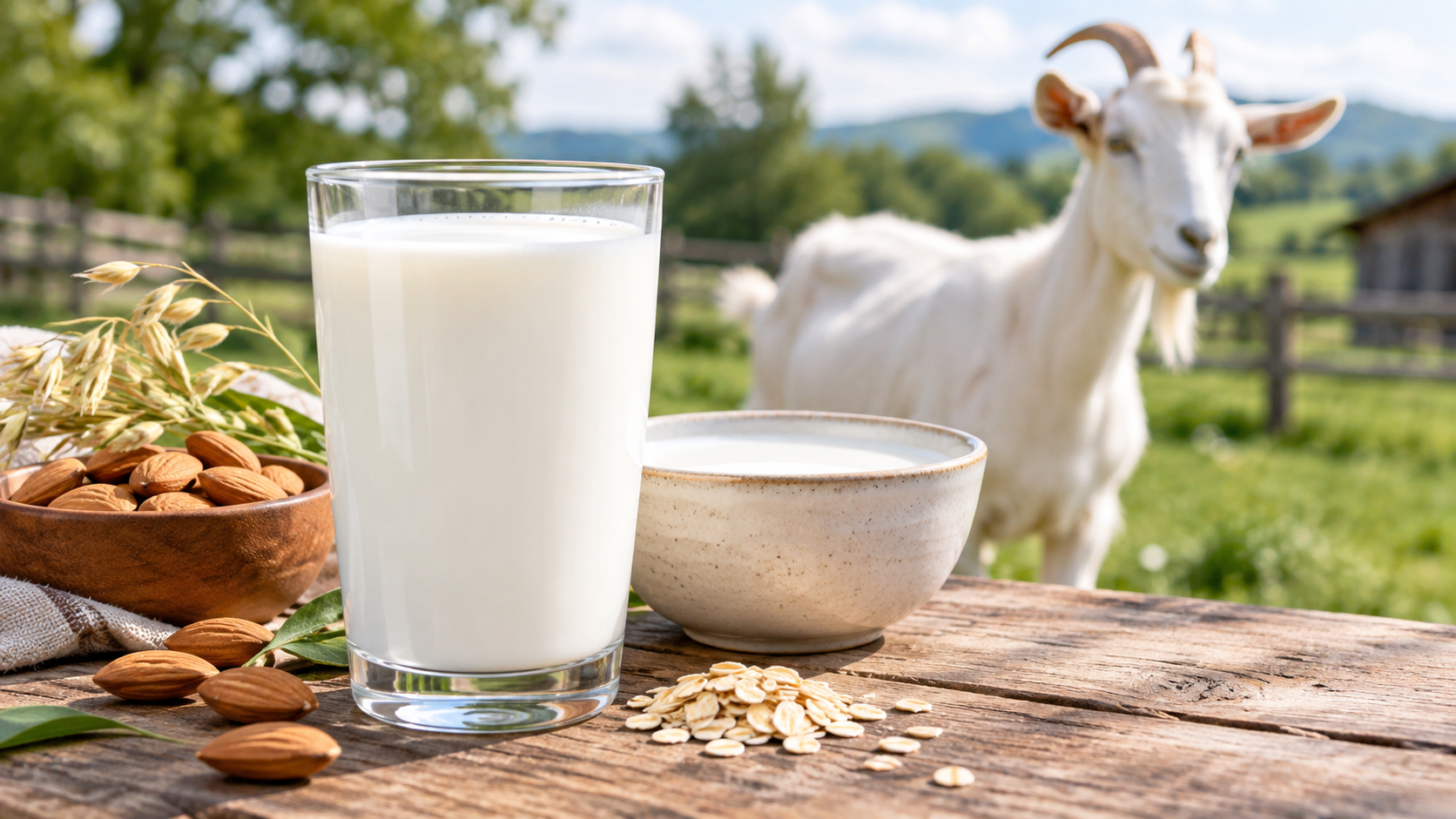
Goat milk nutrition facts show that goat milk is a nutrient-dense dairy food containing protein, fat, carbohydrates, calcium, phosphorus, potassium and several vitamins and minerals. A reference serving of goat milk provides about 69 calories, 3.6 grams of protein, 4.1 grams of fat and 4.5 grams of carbohydrates per 100 grams.
Goat milk is nutritionally similar to cow’s milk, but the two differ in their protein composition, fatty-acid profile and lactose concentration. Goat milk still contains lactose, so it is not lactose-free.
This guide covers the complete goat milk nutrition facts, including calories, protein, fat, carbohydrates, lactose, vitamins, minerals, serving sizes, and how goat milk compares with cow’s milk.
Goat Milk Nutrition Facts at a Glance
The following reference values are based on the goat milk entry used in the supplied nutrition data, with added vitamin D. The values are given per 100 grams.
| Nutrient | Amount per 100 g |
|---|---|
| Calories | 69 kcal |
| Protein | 3.6 g |
| Total fat | 4.1 g |
| Saturated fat | 2.7 g |
| Carbohydrates | 4.5 g |
| Sugars | 4.5 g |
| Fiber | 0 g |
| Calcium | 134 mg |
| Phosphorus | 111 mg |
| Potassium | 204 mg |
| Magnesium | 14 mg |
| Sodium | 50 mg |
| Zinc | 0.3 mg |
| Iron | 0.05 mg |
| Copper | 0.05 mg |
| Selenium | 1.4 µg |
| Vitamin A | 57 µg |
| Vitamin C | 1.3 mg |
| Vitamin D | 1.3 µg |
| Vitamin B1 | 0.05 mg |
| Vitamin B2 | 0.14 mg |
| Vitamin B3 | 0.28 mg |
| Vitamin B5 | 0.31 mg |
| Vitamin B6 | 0.05 mg |
| Vitamin B12 | 0.07 µg |
| Folate | 1 µg |
| Vitamin E | 0.07 mg |
| Vitamin K | 0.3 µg |
| Choline | 16 mg |
The underlying nutrition data list 69 kcal, 3.6 g protein, 4.1 g fat and 4.5 g carbohydrates per 100 g, along with the individual vitamin and mineral values above.
Important note about goat milk nutrition
These numbers should be treated as reference values, not as a guarantee for every bottle or batch of goat milk. Studies show that goat milk composition can vary substantially according to breed, season, lactation stage and production conditions. Reviews report ranges of approximately 3.0–5.2% protein, 3.0–7.2% fat and 3.2–5.0% lactose. (PubMed Central (PMC))
Goat Milk Nutrition Facts Per Cup
A standard cup of the referenced goat milk weighs approximately 244 grams.
Using the per-100-gram values, one cup provides approximately:
| Nutrient | Per 1 cup |
|---|---|
| Calories | 168 kcal |
| Protein | 8.8 g |
| Total fat | 10.0 g |
| Saturated fat | 6.6 g |
| Carbohydrates | 11.0 g |
| Calcium | 327 mg |
| Phosphorus | 271 mg |
| Potassium | 498 mg |
| Magnesium | 34 mg |
| Sodium | 122 mg |
These are calculated from the 244-gram serving size and the reference values above. FoodStruct’s serving-size data likewise lists approximately 168 calories for 1 cup of goat milk.
Goat Milk Nutrition Facts Per 100 mL
Because milk is frequently measured in milliliters, it is useful to convert the nutrition information to a 100 mL serving.
The exact weight-to-volume conversion varies slightly with milk composition, so the following should be considered approximate:
| Nutrient | Approx. per 100 mL |
|---|---|
| Calories | about 69 kcal |
| Protein | about 3.6 g |
| Fat | about 4.1–4.5 g |
| Carbohydrates | about 4.3–4.5 g |
| Calcium | about 130–140 mg |
Published reviews give goat milk an average composition in this general range, although individual samples can differ. One review reports an average of approximately 3.5% protein, 3.8% fat and 4.1% lactose, while another review shows considerably wider ranges across goat milks. (PubMed Central (PMC))
How Many Calories Are in Goat Milk?
Goat milk contains approximately 69 calories per 100 grams in the reference nutrition data.
A 1-cup serving of approximately 244 grams contains about 168 calories.
The calorie content mainly comes from:
- Fat
- Protein
- Lactose
The calorie content can change depending on the milk’s fat concentration. Goat milk composition varies naturally, so whole goat milk from different sources may not have exactly the same calorie content. (PubMed Central (PMC))
How Much Protein Is in Goat Milk?
Goat milk provides approximately 3.6 grams of protein per 100 grams.
One cup provides roughly 8.8 grams of protein.
The protein consists primarily of casein and whey proteins. Goat and cow milk have broadly similar basic protein structures, but the proportions of individual proteins and casein fractions differ. (PubMed Central (PMC))
Protein in goat milk contributes amino acids needed for normal growth, tissue maintenance and numerous biological processes.
Is goat milk a good source of protein?
Yes. Goat milk can contribute meaningful amounts of protein to the diet, although it is not as protein-dense as foods such as meat, fish, eggs or many legumes.
How Much Fat Is in Goat Milk?
The reference nutrition data contain approximately 4.1 grams of total fat per 100 grams.
Approximately:
- 2.7 g is saturated fat
- 1.1 g is monounsaturated fat
- 0.15 g is polyunsaturated fat
The fat composition of goat milk is one area where it differs from cow’s milk. Research indicates that goat milk contains relatively greater proportions of some short- and medium-chain fatty acids. (PubMed Central (PMC))
Because whole goat milk contains saturated fat, people monitoring their saturated-fat intake should consider goat milk as part of their overall diet rather than assuming that it is a low-saturated-fat food.
Goat Milk Carbohydrates and Lactose
Goat milk contains approximately 4.5 grams of carbohydrates per 100 grams in the reference data.
Most of the carbohydrate is lactose, the naturally occurring sugar in milk.
This is important because one of the most common misconceptions about goat milk is that it is lactose-free.
Is goat milk lactose-free?
No.
Goat milk naturally contains lactose.
Published reviews generally report approximately 3.2–5.0 grams of lactose per 100 mL, although the exact amount varies. (PubMed Central (PMC))
A study comparing retail goat and cow milk found average lactose concentrations of 4.13 g/100 g for goat milk and 4.52 g/100 g for cow milk in the samples studied. (PubMed Central (PMC))
Therefore, goat milk may contain somewhat less lactose than cow milk in some cases, but it should not be treated as a lactose-free alternative.
Calcium in Goat Milk
Calcium is one of the most notable minerals in goat milk.
The reference data provide approximately 134 mg of calcium per 100 grams.
A cup therefore provides roughly 327 mg of calcium.
Calcium is important for:
- Bone and tooth structure
- Normal muscle function
- Nerve signaling
- Blood clotting
- Cellular processes
Goat milk’s calcium content can make it a useful contributor to daily calcium intake.
Phosphorus in Goat Milk
Goat milk contains approximately 111 mg of phosphorus per 100 grams.
Phosphorus works alongside calcium in maintaining bones and teeth and is also involved in energy metabolism and cellular functions.
One cup provides approximately 271 mg of phosphorus based on the reference serving size.
Potassium in Goat Milk
There are approximately 204 mg of potassium per 100 grams of the referenced goat milk.
Potassium is an essential mineral and electrolyte involved in:
- Fluid balance
- Nerve function
- Muscle contraction
- Normal cellular function
A cup of goat milk provides approximately 498 mg of potassium.
Magnesium, Zinc and Other Minerals in Goat Milk
Goat milk also provides smaller amounts of several other minerals.
Per 100 grams, the reference data contain approximately:
- Magnesium: 14 mg
- Zinc: 0.3 mg
- Copper: 0.05 mg
- Selenium: 1.4 µg
- Iron: 0.05 mg
- Manganese: 0.02 mg
- Sodium: 50 mg
These minerals contribute to normal physiological functions, although goat milk should not be considered a major source of every mineral on this list.
Vitamins in Goat Milk
Goat milk contains several vitamins, although the amount can vary according to the animal’s diet, milk composition and whether the milk has been fortified.
Vitamin A
The reference data provide approximately 57 µg of vitamin A per 100 grams.
Vitamin A is important for normal vision, immune function and maintenance of body tissues.
Vitamin B2
Goat milk contains approximately 0.14 mg of riboflavin (vitamin B2) per 100 grams.
Riboflavin participates in energy metabolism and other normal cellular processes.
Vitamin B12
The reference value is approximately 0.07 µg of vitamin B12 per 100 grams.
Vitamin B12 is needed for normal red blood cell formation, neurological function and DNA synthesis.
Vitamin D
The referenced goat milk contains approximately 1.3 µg of vitamin D per 100 grams.
However, vitamin D levels can vary substantially depending on whether the product is fortified.
For that reason, always check the nutrition label of the specific goat milk you are buying.
Other vitamins
Goat milk also contains smaller amounts of:
- Vitamin B1
- Vitamin B3
- Vitamin B5
- Vitamin B6
- Vitamin C
- Vitamin E
- Vitamin K
- Folate
Goat Milk vs. Cow Milk Nutrition
Goat milk and cow milk have broadly similar nutritional profiles, but they are not identical.
| Nutrient/characteristic | Goat milk | Cow milk |
|---|---|---|
| Protein | About 3–5% depending on milk | About 3–4% |
| Fat | About 3–7% depending on milk | About 3–5% |
| Lactose | About 3.2–5.0% | About 4.4–5.6% |
| Calcium | High | High |
| Phosphorus | High | High |
| Potassium | High | High |
| Fatty acids | Different distribution | Different distribution |
| Casein profile | Different | Different |
These ranges come from published comparisons and reviews rather than representing one universal composition for every product. (PubMed Central (PMC))
One retail-milk study found goat milk had slightly more fat but less protein and lactose than the cow milk samples studied. (PubMed Central (PMC))
Is goat milk healthier than cow milk?
There is no single answer that applies to everyone.
Both can provide important nutrients. Goat milk has some compositional differences that may make it preferable for certain dietary preferences, but those differences do not establish that goat milk is universally healthier than cow milk.
Is Goat Milk Easier to Digest?
Some people report that goat milk feels easier to digest than cow milk.
Researchers have investigated several possible reasons, including differences in:
- Fat globules
- Fatty-acid composition
- Casein proteins
- Lactose concentration
- The structure of the curd formed during digestion
Goat milk has a different protein and fat structure from cow milk, and research has identified differences in its casein and fatty-acid profiles. (PubMed Central (PMC))
However, easier digestion is not guaranteed for everyone.
Can Lactose-Intolerant People Drink Goat Milk?
It depends on the individual.
Because goat milk contains lactose, people with lactose intolerance can still experience digestive symptoms after drinking it.
Some people may tolerate goat milk better than cow milk, particularly when their tolerance is affected by the overall composition of the milk. But goat milk should not be considered a lactose-free product.
If you have significant lactose intolerance, lactose-free dairy products or non-dairy alternatives may be more appropriate.
Can People With a Cow’s Milk Allergy Drink Goat Milk?
Goat milk should not automatically be considered safe for someone with a cow’s milk protein allergy.
Goat milk contains its own milk proteins, and there can be cross-reactivity between milk proteins from different ruminant species.
Anyone with a diagnosed milk allergy should speak with an appropriate healthcare professional before using goat milk as an alternative.
Is Goat Milk Good for You?
For people who tolerate dairy, goat milk can be a nutritious part of a balanced diet.
Its nutritional contributions include:
- Protein
- Calcium
- Phosphorus
- Potassium
- Riboflavin
- Vitamin A
- Vitamin B12
- Fat
- Other vitamins and minerals
Research has also investigated goat milk proteins and other components for potential biological and functional effects. However, research into potential health effects should not be interpreted as proof that goat milk treats or prevents specific diseases. (PubMed Central (PMC))
In practical terms, the strongest reason to include goat milk in your diet is its nutrient content, not claims that it is a cure or treatment.
Goat Milk and Weight Loss
Goat milk is not inherently a weight-loss food.
It contains calories, carbohydrates, protein and fat, so the amount you consume matters when managing total calorie intake.
A cup contains approximately 168 calories in the reference data.
If you are trying to lose weight, goat milk can still fit into your diet, but consider:
- Portion size
- Total calorie intake
- Protein intake
- Saturated fat intake
- Added sugars in flavored products
- Your overall eating pattern
Is Goat Milk Good for Babies?
Regular goat milk should not be used as a replacement for breast milk or properly formulated infant formula unless specifically recommended by a qualified healthcare professional.
Infants have specific nutritional requirements that ordinary animal milk does not necessarily meet.
Goat milk can be consumed by older children when appropriate, but parents should consider the child’s complete nutritional needs.
Raw Goat Milk vs. Pasteurized Goat Milk
Goat milk can be sold either raw or pasteurized depending on the product and local regulations.
Raw milk can contain harmful microorganisms. Pasteurization is used to reduce the risk associated with these pathogens.
The nutritional value of goat milk should therefore be considered separately from food-safety questions.
For consumers who want goat milk as part of their diet, pasteurized goat milk is generally the safer choice.
Does Goat Milk Have More Protein Than Cow Milk?
Not necessarily.
The exact protein content varies between products. Reviews report goat milk protein across a relatively broad range, while studies comparing retail products have found goat milk can contain either similar or somewhat lower protein than cow milk depending on the samples. (PubMed Central (PMC))
Therefore, it is better to check the nutrition label of the specific products being compared.
Does Goat Milk Have More Calcium Than Cow Milk?
Both goat milk and cow milk are good sources of calcium.
The reference goat milk data provide approximately 134 mg of calcium per 100 grams.
However, the exact amount depends on the milk and whether it has been fortified.
Rather than assuming that goat milk always contains more calcium, compare the nutrition labels of the specific products.
Does Goat Milk Contain Fiber?
No.
Goat milk naturally contains 0 grams of dietary fiber.
Fiber is found primarily in plant foods such as:
- Beans
- Whole grains
- Fruits
- Vegetables
- Nuts
- Seeds
Therefore, drinking goat milk does not contribute meaningful dietary fiber to your daily intake.
Is Goat Milk High in Sugar?
The carbohydrates in plain goat milk are primarily naturally occurring lactose rather than added sugar.
The reference nutrition data contain approximately 4.5 grams of carbohydrate per 100 grams.
However, flavored or sweetened goat-milk products can contain additional added sugars.
Always check the product’s nutrition label if you are monitoring sugar intake.
How Much Goat Milk Should You Drink?
There is no universal amount of goat milk that everyone should drink.
For someone who tolerates dairy, goat milk can be included as part of a balanced diet. A typical serving is around one cup, but your appropriate amount depends on your overall nutritional needs and the other foods you consume.
The important point is to consider goat milk as one source of nutrients, rather than relying on it to meet all nutritional requirements.
Goat Milk Nutrition Facts: Frequently Asked Questions
How many calories are in goat milk?
Goat milk contains approximately 69 calories per 100 grams and about 168 calories per 244-gram cup in the referenced nutrition data.
How much protein is in goat milk?
There are approximately 3.6 grams of protein per 100 grams, or about 8.8 grams per cup.
How much fat is in goat milk?
The reference value is approximately 4.1 grams of total fat per 100 grams, including about 2.7 grams of saturated fat.
Does goat milk contain lactose?
Yes. Goat milk naturally contains lactose. Published research generally places goat milk lactose around 3.2–5.0% depending on the milk. (PubMed Central (PMC))
Is goat milk lactose-free?
No. Goat milk is not lactose-free.
Is goat milk high in calcium?
Yes. The reference data provide approximately 134 mg of calcium per 100 grams.
Does goat milk contain vitamin B12?
Yes. Goat milk contains vitamin B12, although the amount varies among products.
Does goat milk contain vitamin D?
Yes, some goat milk products contain vitamin D, particularly fortified products. The reference product contains approximately 1.3 µg per 100 grams.
Is goat milk healthier than cow milk?
Goat milk and cow milk are both nutrient-rich dairy foods. Their nutritional compositions differ, but those differences do not mean goat milk is universally healthier for everyone.
Is goat milk good for lactose intolerance?
It may be tolerated by some people, but it still contains lactose. It should not be considered a lactose-free milk.
Can you drink goat milk if you have a cow’s milk allergy?
Not automatically. Goat milk contains milk proteins that can also cause allergic reactions. Seek professional medical advice if you have a diagnosed milk allergy.
Does goat milk contain fiber?
No. Plain goat milk contains 0 grams of dietary fiber.
Is goat milk good for weight loss?
Goat milk can be included in a weight-management diet, but it still contains calories and fat. Portion size and total calorie intake matter.
Goat Milk Nutrition Facts: Final Takeaway
The most important goat milk nutrition facts are that goat milk provides approximately 69 calories, 3.6 grams of protein, 4.1 grams of fat and 4.5 grams of carbohydrates per 100 grams. It is also a useful source of calcium, phosphorus and potassium, along with smaller amounts of numerous vitamins and minerals.
A typical 244-gram cup provides approximately 168 calories, 8.8 grams of protein, 10 grams of fat and 327 mg of calcium based on those reference values.
Goat milk is nutritionally similar to cow milk but has differences in its protein, fat and lactose composition. Importantly, goat milk contains lactose and is not automatically suitable for people with milk allergies. Its composition also varies according to breed, season, lactation stage and other production factors. (PubMed Central (PMC))
For someone who tolerates dairy, pasteurized goat milk can be a nutritious addition to a balanced diet. The best way to determine the exact nutrition of a particular product, however, is to check its nutrition label.
Sources and data note
The numerical reference values used above are based primarily on the goat-milk nutrition data supplied for comparison, which identifies the underlying FoodData Central record as its source. Published scientific reviews were also used to explain why goat milk composition varies and to provide context for comparisons with cow milk. (PubMed Central (PMC))
