
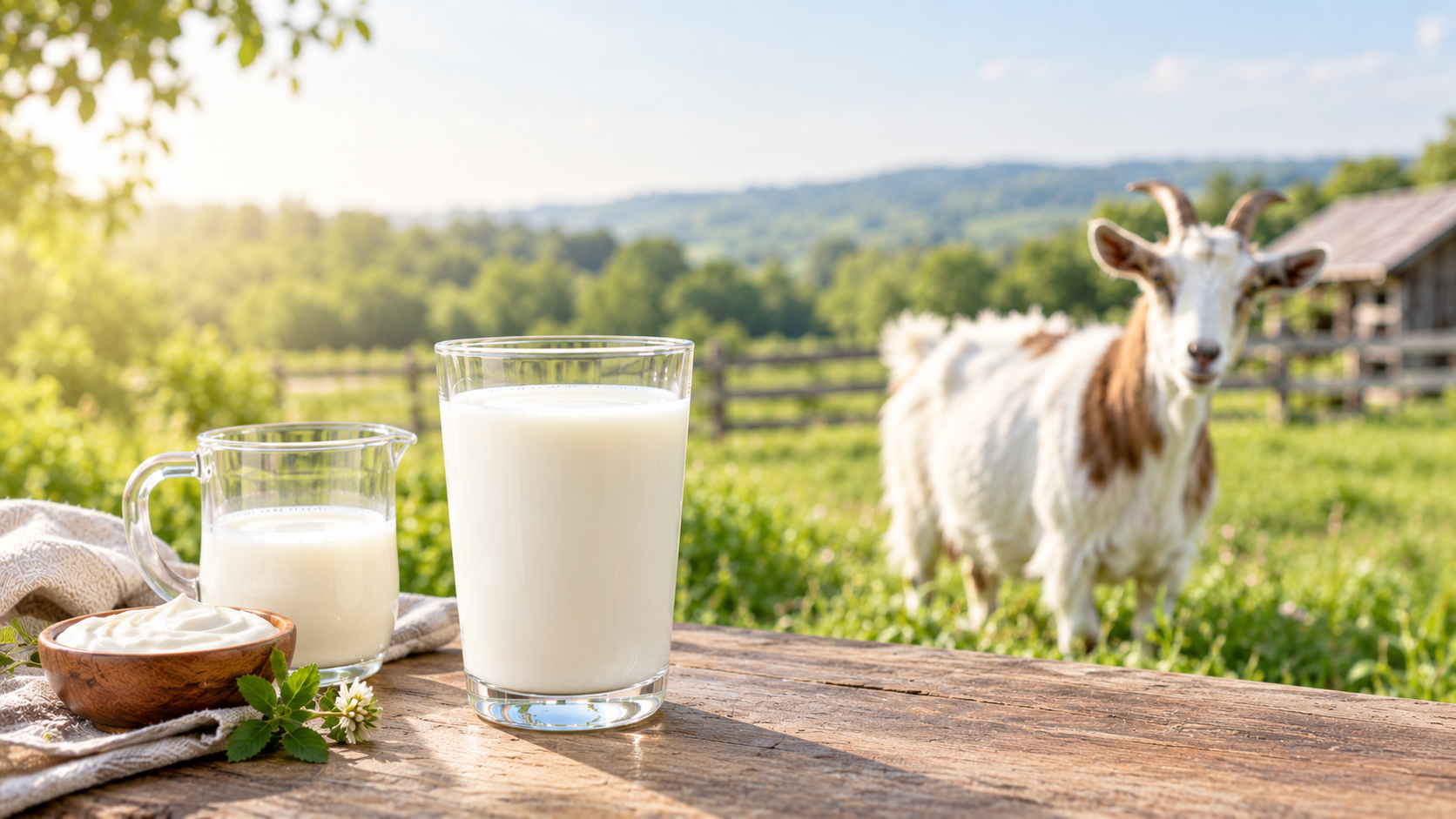
Goat milk fat content is typically around 3.5% to 4.5% in whole goat milk, although the exact amount can vary depending on the goat’s breed, diet, stage of lactation, season, and how the milk is processed.
In practical terms, 100 mL of whole goat milk generally provides about 3.5–4.5 grams of fat, while a 240 mL cup may provide roughly 8.5–11 grams of fat.
If you’re comparing goat milk with cow milk, watching your calorie intake, or simply trying to understand goat milk nutrition, the amount and type of fat are important parts of the picture.
How Much Fat Is in Goat Milk?
Whole goat milk generally contains approximately 3.5–4.5 grams of fat per 100 mL.
The exact nutritional value can vary considerably between fresh milk and commercial products.
| Amount of whole goat milk | Approximate total fat |
|---|---|
| 100 mL | 3.5–4.5 g |
| 150 mL | 5.3–6.8 g |
| 200 mL | 7–9 g |
| 240 mL (about 1 cup) | 8.5–11 g |
| 250 mL | 8.8–11.3 g |
These figures are approximate rather than a universal standard. For packaged goat milk, the nutrition facts label is the best source for the exact fat content.
What Is the Fat Percentage of Goat Milk?
The fat percentage of whole goat milk is commonly around 3.5% to 4.5%.
For example, goat milk containing 4 grams of fat per 100 grams of milk has approximately 4% milk fat.
However, goat milk is a natural product, so its composition isn’t identical from one animal or product to another.
Some goat breeds can produce milk with considerably higher fat concentrations, while other goats may produce milk with lower fat concentrations.
This is why it is more accurate to give a range rather than claim that all goat milk contains exactly one percentage of fat.
Is Goat Milk High in Fat?
Whole goat milk can be considered a moderate-fat dairy food, rather than a low-fat food.
Its fat content is broadly comparable to whole cow milk.
The fat contributes to:
- Calories
- Creaminess
- Flavor
- Mouthfeel
- Energy
- The absorption of fat-soluble vitamins
If you are trying to reduce your fat or calorie intake, the serving size and type of goat milk matter.
Whole goat milk contains substantially more fat than a skim or fat-reduced product.
What Types of Fat Are in Goat Milk?
Goat milk doesn’t contain just one type of fat. Its milk fat consists of a mixture of different fatty acids.
Saturated Fat
A significant portion of goat milk fat is saturated fat.
Saturated fat occurs naturally in dairy products, including both goat milk and cow milk.
If you are monitoring saturated fat, consider goat milk as part of your overall dietary intake rather than looking at total fat alone.
Monounsaturated Fat
Goat milk also contains monounsaturated fatty acids.
These are unsaturated fats found naturally in a variety of foods.
Polyunsaturated Fat
Smaller quantities of polyunsaturated fatty acids are also present in goat milk.
The exact fatty-acid profile can vary depending on factors such as the goat’s diet, breed, stage of lactation, and farming conditions.
Goat Milk Fat Content vs Cow Milk
One of the most common questions is whether goat milk contains more fat than cow milk.
The answer is sometimes, but the difference is not necessarily large.
Whole goat milk commonly falls around 3.5–4.5% fat, while whole cow milk is often around 3–4% fat, depending on the breed, product, and processing.
| Comparison | Whole Goat Milk | Whole Cow Milk |
|---|---|---|
| Typical fat | ~3.5–4.5 g/100 mL | ~3–4 g/100 mL |
| Protein | ~3–3.5 g/100 mL | ~3–3.5 g/100 mL |
| Lactose/carbohydrates | ~4–5 g/100 mL | ~4.5–5 g/100 mL |
| Calories | Varies | Varies |
These are general ranges and shouldn’t be treated as the exact nutritional composition of every product.
Goat milk is therefore not automatically a low-fat alternative to cow milk.
Does Goat Breed Affect Milk Fat Content?
Yes. Goat breed can have a significant effect on milk composition.
Different dairy goat breeds can produce milk with different concentrations of fat and protein.
For example, some breeds are selected for high milk production, while others are known for producing milk with relatively higher milk-fat concentrations.
This creates an important trade-off: a goat that produces a large quantity of milk does not necessarily produce milk with the highest percentage of fat.
Other factors, including nutrition and stage of lactation, also influence the final fat concentration.
How Does a Goat’s Diet Affect Milk Fat?
A goat’s diet can influence the composition of its milk.
Feed may include combinations of:
- Pasture
- Grass
- Hay
- Silage
- Grains
- Legumes
- Root vegetables
- Concentrated feeds
The balance of nutrients in the diet can affect both milk production and milk composition.
This is one reason milk from two goats can have different fat percentages even when they belong to the same breed.
Does Goat Milk Fat Change During Lactation?
Yes.
Milk composition can change throughout the lactation period.
The fat concentration may differ during different stages of milk production, meaning that milk produced shortly after kidding may not have exactly the same composition as milk produced later.
The amount of milk being produced can also affect the concentration of some milk components.
Therefore, the fat percentage of goat milk should be viewed as a range rather than a fixed number.
Does Season Affect Goat Milk Fat Content?
Season can also influence goat milk composition.
Changes in:
- Feed availability
- Pasture quality
- Temperature
- Goat nutrition
- Stage of lactation
can all contribute to changes in milk composition.
For goats raised primarily on pasture, seasonal differences in available forage can be particularly relevant.
Goat Milk Fat per 100 mL
If you’re specifically searching for goat milk fat per 100 mL, a useful general estimate for whole goat milk is:
About 3.5–4.5 grams of fat per 100 mL.
However, the actual value can be higher or lower depending on the product.
For accurate calorie or macronutrient tracking, use the nutrition label on the particular goat milk you are drinking.
Goat Milk Fat per Cup
A cup of goat milk is approximately 240 mL.
Using the typical range of 3.5–4.5 grams of fat per 100 mL, one cup of whole goat milk may provide approximately:
8.5–11 grams of total fat.
The exact amount depends on the milk’s fat percentage and the size of the serving.
Does Goat Milk Fat Make It Creamy?
Yes.
Milk fat contributes to the rich texture and creamy mouthfeel of milk.
Whole goat milk can taste rich because its natural milk fat contributes to both its texture and flavor.
The fat also carries various flavor compounds, which can influence the overall sensory characteristics of goat milk.
Does Goat Milk Fat Affect Calories?
Yes.
Fat provides approximately 9 calories per gram, making it one of the major contributors to the energy content of milk.
For example, milk containing more fat will generally contain more calories when other nutritional factors are similar.
This means that whole goat milk will generally provide more calories than a low-fat or skim goat milk product.
However, total calories also depend on protein, carbohydrates, serving size, and the particular product.
Is Goat Milk Fat Easier to Digest?
Goat milk is sometimes described as easier to digest than cow milk.
One reason often discussed is that goat milk contains relatively small fat globules.
However, this does not mean everyone will digest goat milk more easily.
Individual digestive responses vary, and factors other than fat globule size can influence how a person responds to milk.
If dairy regularly causes digestive symptoms, changing from cow milk to goat milk may not necessarily solve the problem.
Is Goat Milk Fat Healthy?
Goat milk can be part of a balanced diet, but its fat should be considered alongside the rest of your diet.
Goat milk contains useful nutrients, but whole goat milk also contains saturated fat.
Whether whole goat milk is appropriate for you depends on factors such as:
- Your overall diet
- Energy requirements
- Total saturated-fat intake
- Portion size
- Dietary preferences
- Individual nutritional needs
There is no need to classify all goat milk fat as simply “good” or “bad.” The amount consumed and the overall dietary pattern matter.
Is Goat Milk Good for Weight Loss?
Goat milk is not specifically a weight-loss food.
Whole goat milk contains calories from fat, protein, and carbohydrates. Drinking large quantities can therefore add a significant number of calories to your daily intake.
If you’re trying to manage your weight, consider:
- Portion size
- Total daily calorie intake
- Fat intake
- Protein intake
- Added sugars in flavored products
- Your overall eating pattern
Lower-fat goat milk products may contain fewer calories than whole goat milk, but the exact nutritional profile depends on the product.
Does Removing Fat Change Goat Milk?
Yes.
Processing can reduce the amount of fat in goat milk.
Depending on the product, you may find:
- Whole goat milk: retains most of its natural milk fat.
- Reduced-fat goat milk: has some fat removed.
- Low-fat goat milk: contains less fat than whole milk.
- Skim goat milk: has most of the milk fat removed.
Availability varies between countries and manufacturers.
If you’re specifically looking for lower-fat goat milk, check the product’s nutrition label rather than relying on the name alone.
Can You Tell Goat Milk’s Fat Content by Looking at the Cream?
Fresh, non-homogenized goat milk can naturally separate when left undisturbed, allowing some cream to rise to the top.
However, the thickness of the cream layer is not a reliable way to calculate the milk’s exact fat percentage.
Cream separation depends on several factors, including:
- Fat globule characteristics
- Temperature
- Storage time
- Processing
- Homogenization
- Milk composition
A laboratory analysis or reliable nutrition information is much more appropriate when an accurate fat percentage is required.
Does Fresh Goat Milk Have More Fat Than Commercial Goat Milk?
Not necessarily.
Fresh goat milk can have a naturally variable fat content because it comes directly from an animal whose milk composition changes over time.
Commercial goat milk may undergo processing and standardization, depending on the manufacturer and local regulations.
Some products may therefore have a different fat concentration from fresh farm milk.
The word “fresh” alone does not guarantee that goat milk has a higher fat content.
Goat Milk Fat and Nutrition
Fat is only one part of goat milk’s nutritional profile.
Goat milk also provides nutrients such as:
- Protein
- Calcium
- Phosphorus
- Potassium
- Riboflavin
- Vitamin B12
- Other vitamins and minerals
The precise nutritional values vary by product and processing.
For this reason, goat milk should be evaluated based on its complete nutrition profile rather than its fat content alone.
Can Babies Have Goat Milk Fat?
Plain goat milk should not be used as a replacement for breast milk or infant formula for babies under 12 months unless a qualified healthcare professional specifically recommends an appropriate product or approach.
Although goat milk naturally contains fat, protein, minerals, and other nutrients, ordinary goat milk does not have the nutritional composition required to serve as a complete replacement for breast milk or properly formulated infant formula.
Goat-milk-based infant formulas are specially formulated products and are different from ordinary goat milk.
How Much Goat Milk Fat Should You Consume?
There is no single amount of goat milk fat that is appropriate for everyone.
Your dietary needs depend on your age, energy requirements, health circumstances, overall diet, and other sources of dietary fat.
If you regularly drink goat milk, consider the serving size and the nutrition information on the product.
For people who need to limit saturated fat, lower-fat dairy products may be a useful option.
Frequently Asked Questions About Goat Milk Fat Content
How much fat is in goat milk?
Whole goat milk typically contains about 3.5–4.5 grams of fat per 100 mL, although the exact amount varies according to breed, diet, lactation stage, and processing.
What is the fat percentage of goat milk?
The fat percentage of whole goat milk is commonly around 3.5% to 4.5%, but some goat milk can fall outside this range.
How much fat is in 100 mL of goat milk?
Approximately 3.5–4.5 grams of fat can be found in 100 mL of whole goat milk.
How much fat is in a cup of goat milk?
A 240 mL cup of whole goat milk may contain approximately 8.5–11 grams of fat, depending on the product.
Is goat milk higher in fat than cow milk?
Goat milk can have slightly more fat than some whole cow milk, but the two overlap considerably. The exact fat content depends on the breed, product, and processing.
Is goat milk high in saturated fat?
Yes. A significant portion of goat milk fat is saturated fat. If you are monitoring saturated fat, consider goat milk as part of your total daily intake.
Does goat breed affect milk fat?
Yes. Different goat breeds can produce milk with different levels of fat and protein. Diet, lactation stage, and other factors also contribute.
Does goat milk have healthy fats?
Goat milk contains a mixture of saturated and unsaturated fatty acids. Whether it fits your diet depends on the amount consumed and your overall nutritional needs.
Does goat milk contain more calories because of its fat?
Fat contributes substantially to the calorie content of milk. Whole goat milk therefore generally contains more calories than lower-fat goat milk products.
Is goat milk fat easier to digest than cow milk fat?
Goat milk has relatively small fat globules, but this does not guarantee easier digestion for everyone. Individual tolerance varies.
Can goat milk help with weight loss?
Goat milk is not inherently a weight-loss food. Whole goat milk contains calories and fat, so portion size and total calorie intake remain important.
Goat Milk Fat Content: The Bottom Line
Whole goat milk typically contains about 3.5–4.5 grams of fat per 100 mL, or approximately 8.5–11 grams per 240 mL cup.
The actual goat milk fat content can vary because of goat breed, diet, stage of lactation, season, and processing.
Goat milk contains saturated as well as unsaturated fats and has a fat content broadly comparable to whole cow milk. Therefore, goat milk should not automatically be considered either a high-fat or low-fat alternative to cow milk.
If you’re tracking your fat or calorie intake, the most reliable approach is to check the nutrition facts for the specific goat milk product you are consuming.
