
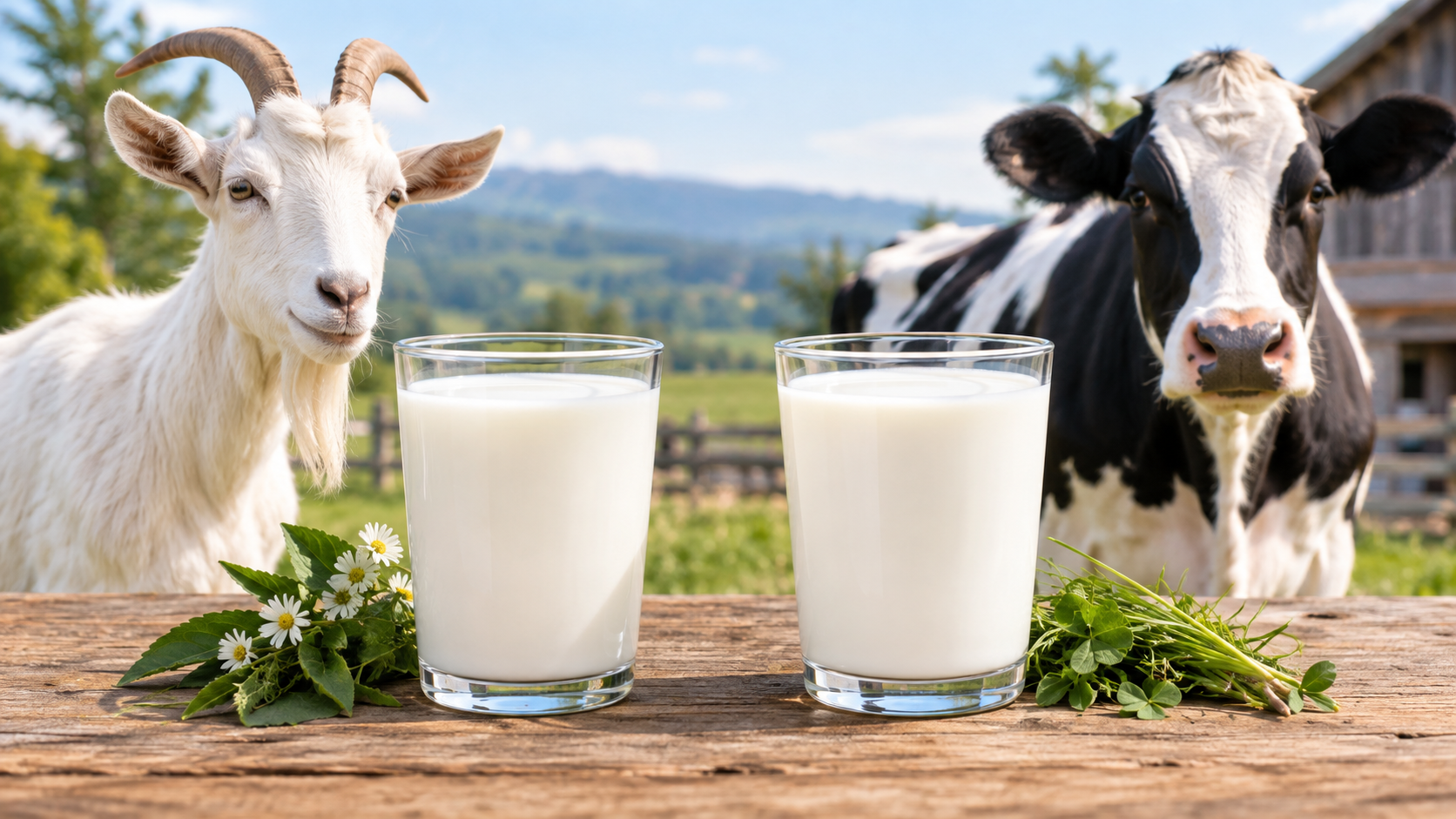
Goat milk vs cow milk is a common comparison for people who want to know which milk provides more nutrients, which is easier to digest, how much protein and calcium each contains, and whether goat milk is a suitable alternative to cow milk.
Both goat milk and cow milk provide important nutrients, including protein, fat, carbohydrates, calcium, phosphorus, potassium, and several vitamins and minerals. However, they differ in their nutritional composition, taste, protein structure, fat composition, lactose content, and availability.
So, is goat milk healthier than cow milk?
There isn’t one answer for everyone. The better choice depends on your nutritional needs, tolerance, dietary preferences, and the specific milk product you choose.
Goat Milk vs Cow Milk: Quick Answer
Goat milk and cow milk are both nutrient-rich dairy foods, but goat milk generally contains slightly more calories, protein, fat, calcium, magnesium, phosphorus, and potassium per cup in the USDA-based comparison cited by Michigan State University Extension. Cow milk is more widely available and is offered in a broader range of products, including lactose-free and fortified varieties.
Goat milk also contains lactose, so it is not lactose-free. Some people who have difficulty tolerating cow milk report that goat milk is easier to tolerate, but people with a diagnosed milk allergy should not assume goat milk is a safe substitute.
Goat Milk vs Cow Milk Nutrition Comparison
One of the easiest ways to understand the difference between goat milk and cow milk is to compare their nutrients per cup.
The following comparison uses the USDA-based figures presented by Michigan State University Extension.
| Nutrient | Goat Milk, 1 cup | Cow Milk, 1 cup |
|---|---|---|
| Calories | 168 | 149 |
| Protein | 9 g | 8 g |
| Fat | 10 g | 8 g |
| Carbohydrates | 11 g | 12 g |
| Fiber | 0 g | 0 g |
| Sugar | 11 g | 12 g |
| Sodium | 122 mg | 105 mg |
| Calcium | 327 mg | 276 mg |
| Magnesium | 34.2 mg | 24.4 mg |
| Phosphorus | 271 mg | 205 mg |
| Potassium | 498 mg | 322 mg |
These figures show that the two milks have broadly similar nutritional profiles, while goat milk provides higher amounts of several nutrients in this particular comparison.
However, nutrition can vary depending on the product, fat level, processing, fortification, and serving size. Always check the nutrition label of the specific milk you are buying.
Goat Milk vs Cow Milk: Calories
In the comparison above, one cup of goat milk provides 168 calories, compared with 149 calories for one cup of cow milk.
The difference is relatively small, but calories can become important when milk is consumed regularly.
The calorie content of milk depends heavily on its fat content. Whole milk generally contains more calories than reduced-fat or skim versions.
Therefore, if you’re comparing goat milk and cow milk for weight management, look at the actual calories per serving rather than assuming one type of milk is automatically lower in calories.
Goat Milk vs Cow Milk: Protein
Both goat milk and cow milk provide high-quality protein.
In the MSU Extension comparison, one cup of goat milk contains 9 grams of protein, while cow milk contains 8 grams.
Protein helps the body:
- Build and maintain muscle
- Repair tissues
- Produce enzymes and hormones
- Support normal body functions
The two milks also contain different protein compositions. This can be relevant to people who react differently to different types of milk.
Goat milk should not, however, be considered a dramatically higher-protein food than cow milk. Both can make useful contributions to daily protein intake.
Goat Milk vs Cow Milk: Fat
Whole goat milk contains more fat than the cow milk shown in the MSU comparison.
The comparison lists:
- Goat milk: 10 grams of fat per cup
- Cow milk: 8 grams of fat per cup
Goat milk also has a different fatty-acid profile and smaller fat globules than cow milk.
The smaller fat globules and other compositional differences are among the reasons goat milk is sometimes described as easier to digest. However, digestion involves many factors, so smaller fat globules do not mean everyone will automatically digest goat milk better.
Goat Milk vs Cow Milk: Carbohydrates and Sugar
Both goat milk and cow milk contain lactose, which is their primary naturally occurring milk sugar.
In the MSU comparison:
- Goat milk contains about 11 grams of carbohydrates
- Cow milk contains about 12 grams
- Goat milk contains about 11 grams of sugar
- Cow milk contains about 12 grams
Neither contains dietary fiber.
This means that goat milk is not a low-carbohydrate or sugar-free alternative to cow milk.
Goat Milk vs Cow Milk: Calcium
Calcium is one of the major nutritional reasons people consume dairy milk.
In the comparison, goat milk provides 327 mg of calcium per cup, while cow milk provides 276 mg.
Calcium is important for:
- Bones and teeth
- Normal muscle function
- Nerve signaling
- Other normal physiological functions
Both goat milk and cow milk can therefore contribute significantly to dietary calcium intake.
Goat Milk vs Cow Milk: Magnesium
The same comparison shows:
- Goat milk: 34.2 mg magnesium
- Cow milk: 24.4 mg magnesium per cup.
Magnesium participates in numerous processes in the body, including normal muscle and nerve function.
The difference illustrates why looking at the complete nutrition profile is more useful than focusing on only one nutrient.
Goat Milk vs Cow Milk: Phosphorus
Goat milk also provides more phosphorus in the cited comparison:
- Goat milk: 271 mg
- Cow milk: 205 mg per cup.
Phosphorus works alongside calcium in maintaining normal bones and teeth and is involved in energy metabolism and other biological processes.
Goat Milk vs Cow Milk: Potassium
Potassium is another mineral where the cited comparison shows a noticeable difference.
One cup provides approximately:
- 498 mg potassium from goat milk
- 322 mg potassium from cow milk
Potassium contributes to normal muscle and nerve function and fluid balance.
Does Goat Milk Have More Vitamins Than Cow Milk?
Goat milk is a source of several vitamins and minerals, including vitamin A and B vitamins.
The MSU Extension article specifically describes goat milk as an excellent source of protein, calcium, potassium, phosphorus, magnesium, and vitamin A.
However, vitamin levels can vary between individual milk products.
Fortification is particularly important when comparing commercially sold milk. For example, vitamin D levels may differ depending on whether a product has been fortified.
For this reason, check the nutrition label when comparing specific brands.
Goat Milk vs Cow Milk: Lactose
One of the most important things to understand about goat milk is that it still contains lactose.
Goat milk is therefore not a lactose-free alternative to cow milk.
The MSU Extension article notes that goat milk has about 1% less lactose than cow milk.
That difference is relatively small.
Can someone with lactose intolerance drink goat milk?
Some people with lactose intolerance may tolerate goat milk better than cow milk, but this is not guaranteed.
If lactose is the cause of your symptoms, switching from ordinary cow milk to ordinary goat milk may not solve the problem.
Lactose-free milk is a more predictable option for people who need to limit lactose.
Is Goat Milk Easier to Digest Than Cow Milk?
Some people find goat milk easier to digest than cow milk.
One possible explanation is the difference in fat globules and milk composition. Michigan State University Extension notes that goat milk has smaller fat globules and is naturally homogenized.
However, digestion is individual.
A person who experiences discomfort from cow milk may or may not experience the same symptoms with goat milk.
It’s also important to distinguish lactose intolerance from reactions to milk proteins, because they are not the same thing.
Goat Milk vs Cow Milk and Milk Allergies
Goat milk is sometimes chosen by people who experience problems with cow milk.
However, this needs to be approached carefully.
The MSU article notes that some people with an allergy to cow milk can consume goat milk products without experiencing an allergic reaction, while also recommending that individuals with dairy intolerance be evaluated to determine whether goat milk is appropriate for them.
A cow’s-milk allergy and lactose intolerance are different conditions.
Because goat and cow milk contain related proteins, people with a diagnosed cow’s-milk allergy should not assume goat milk is safe.
If you’ve had an allergic reaction to dairy, consult a qualified healthcare professional before trying goat milk.
Goat Milk vs Cow Milk: Taste
Taste is another noticeable difference.
Goat milk can have a more distinctive flavor than cow milk. Some people describe it as tangy, rich, earthy, or slightly “goaty.”
Cow milk generally has a milder and more familiar flavor.
The flavor of goat milk can also vary depending on factors such as:
- Feed
- Animal breed
- Freshness
- Handling
- Processing
- Pasteurization
Michigan State University Extension notes that goat milk has a different taste from cow milk and that some people need time to become accustomed to it.
Goat Milk vs Cow Milk: Which Is Healthier?
There is no universal answer that applies to everyone.
Both can provide valuable nutrients.
Goat milk has a different nutritional composition and, in the cited comparison, provides more calories, protein, fat, calcium, magnesium, phosphorus, and potassium per cup.
Cow milk, meanwhile, is widely available and comes in many forms, including different fat levels and lactose-free products.
Instead of asking which milk is universally “healthier,” consider:
- Your nutritional requirements
- Your tolerance to dairy
- Your calorie needs
- Your preference for taste
- Whether you need fortified nutrients
- The particular product you are purchasing
Goat Milk vs Cow Milk for Weight Loss
Neither goat milk nor cow milk automatically causes weight loss.
The key consideration is your overall calorie intake and dietary pattern.
Because the cited comparison lists goat milk at 168 calories per cup and cow milk at 149 calories, goat milk is not automatically the lower-calorie choice.
If reducing calories is your goal, compare whole, reduced-fat, and skim versions of both milks.
The nutrition label is more useful than choosing based solely on whether the milk comes from a goat or cow.
Goat Milk vs Cow Milk for Babies
Regular goat milk should not be used as the main milk for young infants.
Infants have specific nutritional requirements that ordinary animal milk does not adequately meet.
If you’re considering goat-milk-based infant formula, use a product specifically formulated for infants and follow appropriate medical or nutritional guidance.
This is different from giving ordinary goat milk to an older child or adult.
Goat Milk vs Cow Milk for Children
For older children, milk can be part of a balanced diet.
Both goat milk and cow milk can provide protein, calcium, phosphorus, and other nutrients.
Parents should consider the child’s age, overall diet, nutritional requirements, tolerance, and whether the particular milk product is fortified.
Goat milk is not automatically nutritionally superior to cow milk for every child.
Goat Milk vs Cow Milk for Adults
For adults, either milk can fit into a balanced diet if the person tolerates it.
Goat milk may appeal to adults who:
- Prefer its flavor
- Want an alternative to cow milk
- Find it more comfortable to digest
- Like its nutritional profile
Cow milk may appeal to people who:
- Prefer its familiar flavor
- Want greater availability
- Need lactose-free options
- Want different fat levels
- Prefer fortified dairy products
Goat Milk vs Cow Milk: Similarities
Although they have important differences, goat milk and cow milk have many similarities.
Both:
- Contain protein
- Contain fat
- Contain carbohydrates
- Contain lactose
- Provide calcium
- Provide phosphorus
- Provide potassium
- Provide other vitamins and minerals
- Can be used to make yogurt and cheese
- Can contribute to a balanced diet
The biggest differences are in their composition, nutrient amounts, taste, digestibility, and how individual people tolerate them.
Goat Milk vs Cow Milk: Key Differences
| Feature | Goat Milk | Cow Milk |
|---|---|---|
| Calories | 168 per cup in the cited comparison | 149 per cup |
| Protein | 9 g | 8 g |
| Fat | 10 g | 8 g |
| Carbohydrates | 11 g | 12 g |
| Sugar | 11 g | 12 g |
| Calcium | 327 mg | 276 mg |
| Magnesium | 34.2 mg | 24.4 mg |
| Phosphorus | 271 mg | 205 mg |
| Potassium | 498 mg | 322 mg |
| Lactose | Contains lactose | Contains lactose |
| Taste | More distinctive | Generally milder |
| Digestibility | Some people find it easier to tolerate | Generally well tolerated |
| Availability | Less widely available in many markets | Widely available |
The nutrient figures in this table come from the USDA-based comparison published by Michigan State University Extension.
Which Should You Choose: Goat Milk or Cow Milk?
The answer depends on what you’re looking for.
If you want a milk with a distinctive taste
Goat milk may be worth trying.
If you want a widely available milk
Cow milk is generally easier to find.
If you’re comparing protein
Both provide high-quality protein, with the cited comparison showing slightly more protein in goat milk.
If you’re comparing calcium
Both are good sources, with the cited comparison showing more calcium in goat milk.
If you’re avoiding lactose
Neither ordinary goat milk nor ordinary cow milk is lactose-free.
If you have a milk allergy
Don’t assume goat milk is safe simply because it isn’t cow milk. Discuss alternatives with a healthcare professional.
If you’re watching calories
Compare the nutrition labels and fat levels rather than assuming goat milk or cow milk is automatically lower in calories.
Frequently Asked Questions About Goat Milk vs Cow Milk
Is goat milk better than cow milk?
Goat milk and cow milk have different nutritional compositions and characteristics. Goat milk is not automatically better for everyone. The appropriate choice depends on individual nutritional needs, tolerance, preferences, and the specific product.
Does goat milk have more protein than cow milk?
In the USDA-based comparison cited by Michigan State University Extension, goat milk provides 9 grams of protein per cup compared with 8 grams in cow milk.
Does goat milk have more calcium than cow milk?
In the same comparison, goat milk provides 327 mg of calcium per cup compared with 276 mg in cow milk.
Does goat milk have less lactose than cow milk?
Yes, goat milk contains slightly less lactose, but the difference is small. Goat milk still contains lactose and is not lactose-free.
Is goat milk easier to digest?
Some people find goat milk easier to digest. Differences in fat globules and milk composition may contribute, but individual tolerance varies.
Does goat milk taste different from cow milk?
Yes. Goat milk often has a more distinctive flavor than cow milk. Some people enjoy it immediately, while others need time to get used to the taste.
Is goat milk good for lactose intolerance?
Goat milk still contains lactose, so it isn’t a lactose-free solution. Some people may tolerate it differently from cow milk, but tolerance varies.
Can people with a cow milk allergy drink goat milk?
Not necessarily. Goat milk contains proteins that can also trigger reactions in people with milk allergies. Anyone with a diagnosed milk allergy should get appropriate medical advice before trying goat milk.
Is goat milk good for babies?
Ordinary goat milk should not be used as the main milk for young infants. Infant feeding should follow age-appropriate nutritional guidance.
Which has fewer calories, goat milk or cow milk?
In the USDA-based comparison cited by Michigan State University Extension, cow milk has fewer calories: 149 calories per cup compared with 168 calories for goat milk.
Which has more fat, goat milk or cow milk?
In the cited comparison, goat milk has more fat per cup: 10 grams compared with 8 grams in cow milk.
Can goat milk replace cow milk?
For many adults, goat milk can serve as an alternative to cow milk if it fits their nutritional needs and they tolerate it. However, it is not an appropriate replacement in every situation, particularly for young infants or people with certain milk allergies.
Final Takeaway: Goat Milk vs Cow Milk
Goat milk vs cow milk is not simply a question of which milk is better. The two have different nutritional profiles and may suit different people.
In the USDA-based comparison cited by Michigan State University Extension, goat milk provides more calories, protein, fat, calcium, magnesium, phosphorus, and potassium per cup, while cow milk provides slightly more carbohydrates and sugar.
Goat milk also has a distinctive taste and may be easier for some people to tolerate. However, it still contains lactose and should not automatically be considered suitable for people with lactose intolerance or cow’s-milk allergies.
For the most accurate comparison, look at the nutrition label of the specific goat milk and cow milk products you’re considering.
The important differences are nutrition, lactose, protein composition, fat composition, taste, digestibility, fortification, and individual tolerance—not simply whether the milk comes from a goat or a cow.
