
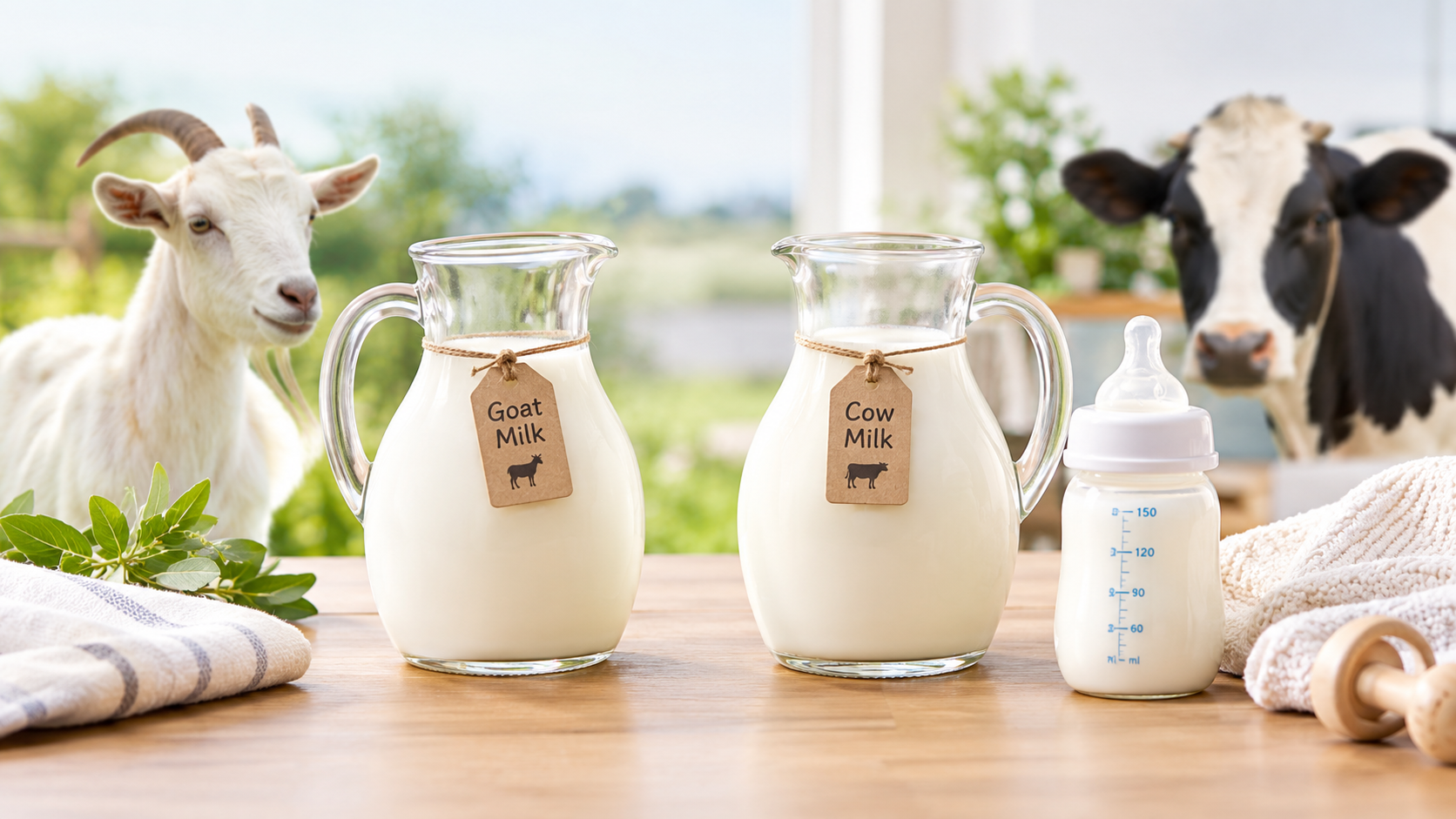
If you are researching goat milk vs cow milk for babies, it is important to know that ordinary goat milk and ordinary cow milk are not the same as infant formula.
For babies younger than 12 months, ordinary goat milk and ordinary cow milk should not replace breast milk or an appropriate infant formula as the baby’s main milk source. Both are nutritionally different from breast milk and are not designed to provide everything an infant needs.
After about 12 months, pasteurized whole goat milk and pasteurized whole cow milk can generally be included as part of a balanced diet.
There is also an important difference between goat milk and goat-milk infant formula, just as there is between cow milk and cow-milk-based infant formula. Infant formulas are specially formulated to meet the nutritional requirements of babies.
Goat Milk vs Cow Milk for Babies: Quick Answer
If you are comparing goat milk and cow milk for a baby, the answer depends mainly on the child’s age.
- Under 12 months: Ordinary goat milk and ordinary cow milk should not be used as the main milk drink.
- 12 months and older: Pasteurized whole goat milk or whole cow milk can generally be offered as part of a varied diet.
- For babies who need formula: Goat-milk infant formula and cow-milk-based infant formula are different from ordinary goat and cow milk.
- For suspected cow’s milk protein allergy: Goat milk is generally not a suitable substitute because its proteins can be similar enough to trigger a reaction.
- For lactose intolerance: Switching from cow milk to goat milk does not remove lactose because both naturally contain lactose.
- For raw milk: Raw goat milk and raw cow milk should not be given to babies or young children.
So, there is no universal answer that goat milk is “better” than cow milk for babies.
Goat Milk vs Cow Milk for Babies at a Glance
| Feature | Goat Milk | Cow Milk |
|---|---|---|
| Main milk for babies under 12 months | No | No |
| Suitable after about 12 months | Generally, if pasteurized | Generally, if pasteurized |
| Contains protein | Yes | Yes |
| Contains lactose | Yes | Yes |
| Provides calcium | Yes | Yes |
| Naturally high in iron | No | No |
| Suitable for cow’s milk protein allergy | Generally no | No |
| Can replace infant formula | No | No |
| Can be used as part of a toddler’s diet | Yes | Yes |
| Raw milk suitable for babies | No | No |
The Most Important Difference: Milk vs Infant Formula
One of the biggest sources of confusion when comparing goat milk and cow milk for babies is the word formula.
Ordinary goat milk is simply milk produced by goats.
Ordinary cow milk is milk produced by cows.
Neither is nutritionally equivalent to infant formula.
Goat-milk infant formula
Goat-milk infant formula is manufactured specifically for infant feeding. It undergoes processing and formulation to provide nutrients required by infants.
It should not be confused with ordinary goat milk from a farm, supermarket or other source.
Cow-milk-based infant formula
Many infant formulas are made using cow’s milk as their starting protein source, but the finished formula is substantially different from ordinary cow milk.
The formula is specially processed and supplemented so that it can meet infant nutritional requirements.
Why this distinction matters
A parent may search for “goat milk for babies” when they actually mean goat-milk infant formula.
These are not interchangeable products.
Likewise:
Goat milk ≠ goat-milk infant formula
and
Cow milk ≠ cow-milk-based infant formula
This distinction is especially important when deciding what to feed a baby younger than 12 months.
Can Babies Drink Goat Milk?
For babies younger than 12 months, ordinary goat milk should not be used as the baby’s main milk source.
Goat milk contains protein, fat, calcium and other nutrients, but its nutritional composition is not designed to meet all the needs of a developing infant.
It is also naturally low in iron and folate.
For babies during the first year, breast milk or an appropriate infant formula should provide the primary milk nutrition unless a healthcare professional recommends another feeding plan.
After about 12 months, pasteurized whole goat milk can generally be introduced as part of a balanced diet.
Can Babies Drink Cow Milk?
Ordinary cow milk should also not be used as the primary milk drink for babies younger than 12 months.
Cow milk provides protein, fat, calcium and other nutrients, but it does not provide the complete nutritional balance required for an infant when used as the main milk source.
After about 12 months, pasteurized whole cow milk can generally become part of a balanced diet.
This does not mean a child should consume large quantities of milk at the expense of other foods.
Goat Milk vs Cow Milk for Babies Under 12 Months
For babies under 12 months, the comparison is relatively straightforward:
Ordinary goat milk and ordinary cow milk are both unsuitable as the main milk source.
The primary milk options during this period are breast milk or an appropriate infant formula.
Babies also begin eating complementary foods at an age appropriate for their development, but these foods do not make ordinary animal milk nutritionally equivalent to infant formula.
Why ordinary goat and cow milk are not enough for young infants
A growing baby needs an appropriate balance of:
- Energy
- Protein
- Fat
- Iron
- Vitamins
- Minerals
- Other essential nutrients
Ordinary animal milk does not have the nutritional composition required to serve as the sole milk source for a young infant.
This is why replacing infant formula with ordinary goat milk or cow milk is not recommended.
Goat Milk vs Cow Milk for Babies 12 Months and Older
The situation changes after about 12 months.
At this stage, milk becomes one part of a child’s overall diet rather than the sole source of nutrition.
A toddler can generally have pasteurized whole goat milk or whole cow milk, assuming there is no allergy or other medical reason to avoid them.
The child should also eat a variety of foods, including:
- Meat
- Fish
- Eggs
- Beans
- Lentils
- Vegetables
- Fruits
- Whole grains
- Yogurt
- Cheese
- Other nutrient-rich foods
The goal is a balanced diet rather than relying heavily on milk.
Goat Milk vs Cow Milk Nutrition
Goat milk and cow milk have many nutritional similarities.
Both can provide:
- Protein
- Fat
- Calcium
- Phosphorus
- Riboflavin
- Vitamin B12
- Calories
- Lactose
The exact amount of each nutrient varies according to the animal, breed, feed, processing and whether the product has been fortified.
Protein
Both goat milk and cow milk contain milk proteins.
However, neither ordinary goat milk nor ordinary cow milk is designed to provide the complete nutritional requirements of a young infant.
After 12 months, the protein in either milk can contribute to a child’s overall diet.
Fat
Whole goat milk and whole cow milk contain fat that contributes energy.
Fat is particularly important during early childhood because young children have relatively high energy requirements.
For toddlers between 12 and 24 months, whole milk is commonly used unless a healthcare professional recommends otherwise.
Calcium
Both goat milk and cow milk are useful sources of calcium.
Calcium supports:
- Bone development
- Teeth
- Muscle function
- Nerve function
Therefore, both types of milk can contribute calcium to a toddler’s diet.
Iron
Iron is an important consideration.
Both ordinary goat milk and cow milk are naturally low in iron.
This is one reason babies should not rely on either as their primary milk source during the first year.
After 12 months, children should obtain iron from a variety of foods such as meat, fish, eggs, beans, lentils and iron-fortified foods.
Folate
Goat milk and cow milk are both relatively poor sources of folate compared with an infant’s overall nutritional requirements.
This is another reason ordinary animal milk should not be used as a replacement for a nutritionally complete infant feeding plan during the first year.
Is Goat Milk Easier to Digest Than Cow Milk for Babies?
One reason parents consider goat milk is the belief that it is easier to digest than cow milk.
Goat milk has differences in its protein structure and fat composition compared with cow milk. Some people may find goat milk more tolerable.
However, that does not mean ordinary goat milk is appropriate for babies under 12 months.
It also does not mean goat milk will solve digestive problems.
If a baby has frequent vomiting, persistent diarrhea, severe constipation, blood in the stool, poor feeding or poor weight gain, switching from cow milk to goat milk without professional advice is not a good approach.
The underlying cause should be evaluated.
Is Goat Milk Better for Babies With Cow’s Milk Allergy?
Generally, no.
Babies with cow’s milk protein allergy may also react to goat milk because the proteins in goat milk are sufficiently similar to those in cow milk.
Therefore, goat milk should not be considered a reliable substitute for babies with cow’s milk protein allergy.
If you suspect that your baby has a milk allergy, speak with a pediatrician or another qualified healthcare professional about appropriate feeding options.
Symptoms that may require medical evaluation
Possible signs of a food or milk allergy can include:
- Hives
- Swelling
- Vomiting
- Diarrhea
- Blood in the stool
- Wheezing
- Difficulty breathing
- Significant feeding problems
Difficulty breathing or severe swelling can be an emergency and requires immediate medical attention.
Goat Milk vs Cow Milk for Lactose Intolerance
Both goat milk and cow milk naturally contain lactose.
Therefore, switching from cow milk to goat milk does not eliminate lactose.
It is also important to distinguish lactose intolerance from cow’s milk protein allergy.
Lactose intolerance
This involves difficulty digesting lactose, the natural sugar in milk.
Cow’s milk protein allergy
This involves an immune reaction to proteins found in milk.
Because these conditions are different, changing from cow milk to goat milk may not solve the problem.
Goat Milk vs Cow Milk for a Baby With a Sensitive Stomach
A baby with digestive symptoms should not automatically be switched to goat milk.
Parents may hear that goat milk is gentler or easier to digest, but digestive symptoms can have many causes.
If your baby regularly experiences:
- Vomiting
- Diarrhea
- Constipation
- Excessive discomfort
- Blood in the stool
- Feeding difficulties
- Poor weight gain
talk with a healthcare professional before changing the baby’s main milk source.
Goat Milk Formula vs Cow Milk Formula for Babies
This is a separate comparison from ordinary goat milk vs cow milk.
Goat-milk infant formula
Goat-milk infant formula is specifically manufactured for infant feeding.
It is not simply goat milk placed into a bottle.
The product is formulated and processed to provide the nutritional composition required for infants.
Cow-milk-based infant formula
Cow-milk-based infant formula is also specially manufactured for babies.
Although cow milk may be used as the starting ingredient for its proteins, the finished formula is not the same as ordinary cow milk.
It is formulated to provide appropriate infant nutrition.
Which formula is better?
There is no universal answer that goat-milk infant formula is better than cow-milk-based infant formula.
The appropriate formula depends on the baby’s individual circumstances, the product available in the country and any medical or nutritional needs.
Parents should follow the preparation instructions on the formula packaging and seek professional advice when their baby has feeding problems, allergies or growth concerns.
Goat Milk vs Cow Milk for Babies: Age-by-Age Guide
| Age | Ordinary Goat Milk | Ordinary Cow Milk | Infant Feeding |
|---|---|---|---|
| 0–5 months | Not a main milk source | Not a main milk source | Breast milk or appropriate infant formula |
| Around 6–11 months | Not a replacement for breast milk/formula | Not a replacement for breast milk/formula | Breast milk or appropriate infant formula remains important while complementary foods are introduced |
| Around 12 months+ | Can generally be introduced if pasteurized | Can generally be introduced if pasteurized | Milk becomes part of a broader diet |
Can a 6-Month-Old Drink Goat Milk?
A 6-month-old should not use ordinary goat milk as the primary milk source.
At around this age, babies may begin complementary foods when developmentally ready, but breast milk or appropriate infant formula remains an important source of nutrition.
Goat milk should not be used as a substitute for infant formula.
Can a 9-Month-Old Drink Cow Milk?
A 9-month-old should not use ordinary cow milk as the primary milk drink.
Cow milk can be an ingredient in some foods, but it should not replace breast milk or appropriate infant formula as the baby’s main milk source.
Can a 1-Year-Old Drink Goat Milk?
Generally, yes.
After about 12 months, a child can usually have pasteurized whole goat milk as part of a balanced diet.
However, goat milk should not replace foods containing iron and other important nutrients.
Can a 1-Year-Old Drink Cow Milk?
Generally, yes.
Pasteurized whole cow milk can generally be introduced at around 12 months as part of a balanced diet.
The child should continue eating a variety of nutrient-rich foods rather than relying primarily on milk.
How Much Goat Milk or Cow Milk Should a Toddler Have?
After 12 months, milk should be treated as part of the child’s diet rather than the entire diet.
Too much milk can reduce a child’s appetite for other foods, including iron-rich foods.
Instead of focusing only on the type of milk, consider the child’s total daily diet.
If you are unsure how much milk your child should have, ask your pediatrician or another qualified healthcare professional for guidance based on the child’s age, growth and diet.
Can Babies Drink Raw Goat Milk?
No.
Raw goat milk can contain harmful microorganisms that can cause serious illness.
Babies and young children are particularly vulnerable to foodborne infections.
The same concern applies to raw cow milk.
If giving goat or cow milk to a child after 12 months, choose pasteurized milk and store it according to the manufacturer’s instructions.
Can You Give Homemade Goat Milk to a Baby?
Homemade goat milk should not be used as a substitute for infant formula.
Adding water, cereals, sugar or other ingredients does not make ordinary goat milk nutritionally equivalent to infant formula.
Improper preparation can also create nutritional and food-safety problems.
For babies younger than 12 months, use breast milk or an appropriate infant formula as the primary milk source unless a healthcare professional has provided a different feeding plan.
Goat Milk vs Cow Milk for Babies: Pros and Cons
Goat Milk
Potential advantages
- Provides protein and calcium
- Can be part of a balanced toddler diet after about 12 months
- Has a different protein and fat composition from cow milk
- Some people may find its taste or texture preferable
Limitations
- Not appropriate as the main milk source for young infants
- Naturally low in iron
- Contains lactose
- Not a reliable alternative for cow’s milk protein allergy
- Raw goat milk can carry harmful microorganisms
Cow Milk
Potential advantages
- Provides protein and calcium
- Widely available
- Can be part of a balanced toddler diet after about 12 months
- Familiar nutritional option for young children
Limitations
- Not appropriate as the main milk source for babies under 12 months
- Naturally low in iron
- Contains lactose
- Can trigger symptoms in children with cow’s milk protein allergy
- Raw cow milk can carry harmful microorganisms
Goat Milk vs Cow Milk for Babies: Which Is Better?
The answer depends on the baby’s age and the form of milk being considered.
For babies under 12 months
Ordinary goat milk and ordinary cow milk should not be used as the primary milk source.
The relevant comparison is usually between breast milk and appropriate infant formula rather than ordinary animal milk.
For babies who need infant formula
The comparison should be between properly manufactured goat-milk infant formula and cow-milk-based infant formula, not ordinary goat milk and cow milk.
For children around 12 months and older
Both pasteurized whole goat milk and pasteurized whole cow milk can generally be included in a balanced diet.
Neither should be considered automatically superior for every child.
For children with suspected cow’s milk protein allergy
Goat milk is generally not an appropriate substitute because of the similarity between the milk proteins.
A healthcare professional can recommend an appropriate alternative.
Goat Milk vs Cow Milk for Babies: Key Differences
The biggest differences can be summarized this way:
1. Before 12 months:
Neither ordinary goat milk nor ordinary cow milk should replace breast milk or appropriate infant formula.
2. After about 12 months:
Both pasteurized whole goat milk and whole cow milk can generally be included in a balanced diet.
3. Goat milk is not hypoallergenic:
A baby with cow’s milk protein allergy may also react to goat milk.
4. Both contain lactose:
Goat milk is not lactose-free.
5. Both are low in iron:
Young children need iron-rich foods in addition to milk.
6. Formula is different from ordinary milk:
Goat-milk infant formula and cow-milk-based infant formula are specially formulated for infants.
7. Raw milk should be avoided:
Neither raw goat milk nor raw cow milk is appropriate for babies.
Frequently Asked Questions About Goat Milk vs Cow Milk for Babies
Is goat milk better than cow milk for babies?
Not necessarily. For babies under 12 months, ordinary goat milk and cow milk should not be used as the main milk source. After about 12 months, both can generally be included in a balanced diet if pasteurized and appropriate for the child.
Is goat milk safer than cow milk for babies?
Ordinary goat milk is not automatically safer than cow milk for babies. Both should be avoided as the primary milk source during the first year.
Is goat milk easier to digest than cow milk for babies?
Goat milk has different protein and fat characteristics, and some people may tolerate it differently. However, ordinary goat milk is not an appropriate replacement for infant formula in babies under 12 months.
Can a 6-month-old drink goat milk?
Ordinary goat milk should not be used as the baby’s main milk source at 6 months. Breast milk or appropriate infant formula should remain the primary milk source.
Can a 9-month-old drink cow milk?
Ordinary cow milk should not replace breast milk or appropriate infant formula as the primary milk drink for a 9-month-old.
Can a 1-year-old drink goat milk?
Generally, yes. Pasteurized whole goat milk can generally be offered from around 12 months as part of a balanced diet.
Can a 1-year-old drink cow milk?
Generally, yes. Pasteurized whole cow milk can generally be included in a balanced diet from around 12 months.
Is goat milk good for babies with cow’s milk allergy?
Goat milk is generally not recommended as an alternative for babies with cow’s milk protein allergy because the proteins can be similar enough to cause a reaction.
Does goat milk have lactose?
Yes. Goat milk naturally contains lactose.
Is goat milk lactose-free?
No. Goat milk naturally contains lactose.
Does goat milk have more iron than cow milk?
Neither ordinary goat milk nor cow milk is a good source of iron for meeting an infant’s needs. Children need iron from other foods or appropriate infant nutrition sources.
Can goat milk replace infant formula?
No. Ordinary goat milk should not replace infant formula. Goat-milk infant formula is a specially formulated product and is different from ordinary goat milk.
Is goat-milk formula the same as goat milk?
No. Goat-milk infant formula is specially manufactured and formulated for infants. Ordinary goat milk is not nutritionally equivalent to infant formula.
Is cow-milk formula the same as cow milk?
No. Cow-milk-based infant formula is specially formulated for babies and is nutritionally different from ordinary cow milk.
Can babies drink raw goat milk?
No. Raw goat milk can contain harmful microorganisms and should not be given to babies or young children.
Can babies drink raw cow milk?
No. Raw cow milk can contain harmful microorganisms and should not be given to babies or young children.
Final Takeaway
When comparing goat milk vs cow milk for babies, the baby’s age and the type of milk matter more than simply choosing one animal milk over the other.
For babies under 12 months, ordinary goat milk and ordinary cow milk should not replace breast milk or an appropriate infant formula as the primary milk source.
For children around 12 months and older, pasteurized whole goat milk and whole cow milk can generally be included as part of a varied, balanced diet.
Goat milk is not automatically easier to digest, more nutritious or safer than cow milk. It also is not a reliable alternative for babies with cow’s milk protein allergy.
Most importantly, do not confuse ordinary goat milk or cow milk with goat-milk infant formula or cow-milk-based infant formula. Infant formulas are specifically formulated to meet the nutritional needs of babies.
If your baby has persistent vomiting, diarrhea, blood in the stool, feeding difficulties, allergic symptoms or poor weight gain, speak with a pediatrician or qualified healthcare professional before changing the baby’s main milk source.
This article is for general educational information and does not replace individualized medical advice from your child’s healthcare professional.
