
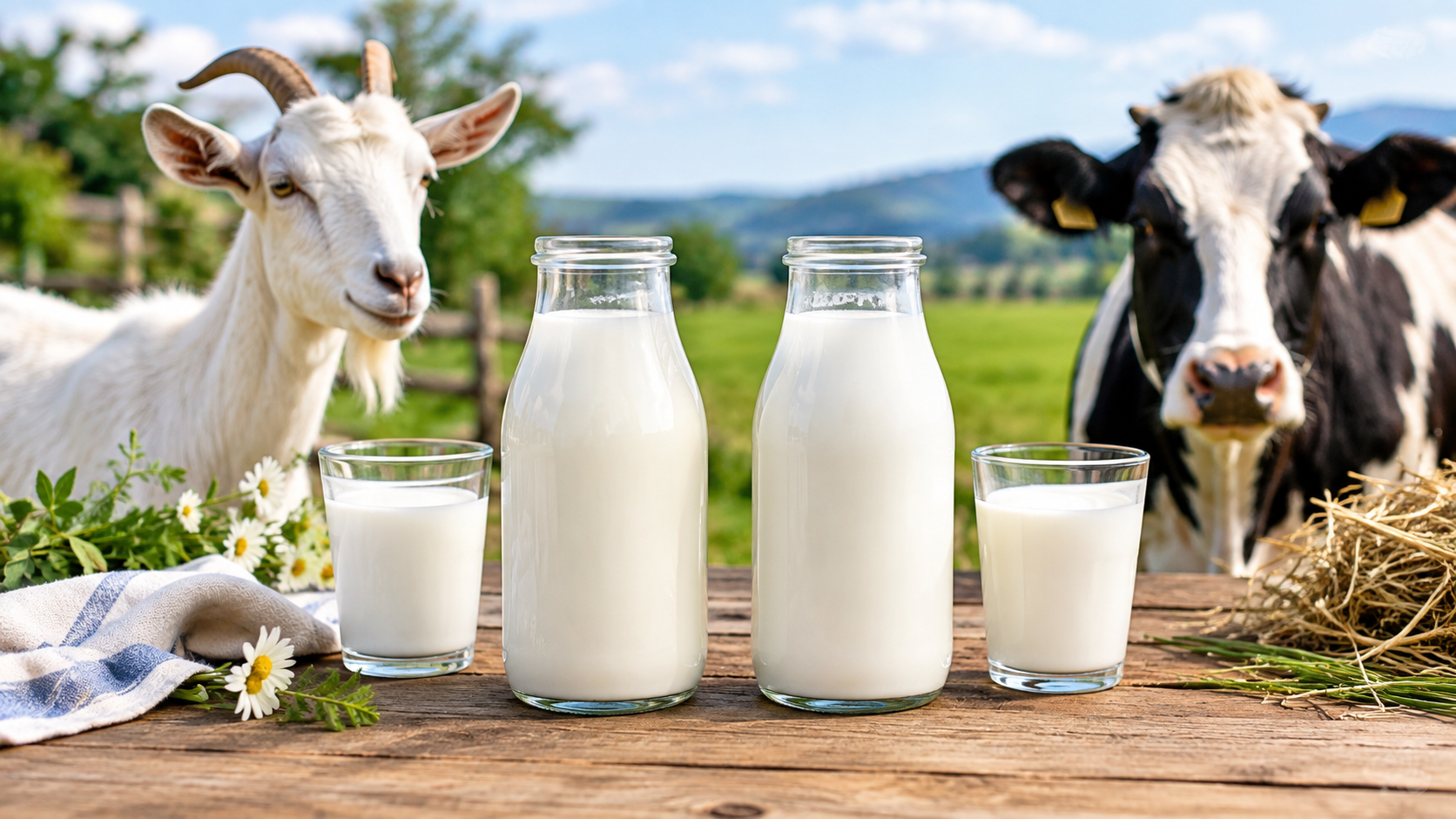
Goat milk is often considered easier to digest than cow milk, but it is not automatically easier for everyone. Differences in protein structure, fat composition, and the way the milk forms curds during digestion may make goat milk feel gentler on the stomach for some people. However, goat milk still contains lactose and milk proteins, so people with lactose intolerance or a cow’s-milk protein allergy may not necessarily tolerate it better.
If you are wondering whether switching from cow milk to goat milk could improve digestion, the answer depends largely on why cow milk causes digestive symptoms in the first place.
Goat Milk vs. Cow Milk for Digestion
Both goat milk and cow milk contain water, protein, fat, lactose, vitamins, and minerals. The main differences are in their protein and fat composition.
| Feature | Goat Milk | Cow Milk |
|---|---|---|
| Lactose | Contains lactose | Contains lactose |
| Protein | Different proportions of milk proteins | Different proportions of milk proteins |
| Fat | Contains relatively small fat globules | Generally larger fat globules |
| Digestive response | May be easier for some people | Can cause digestive discomfort in some people |
| Milk allergy | Can still cause an allergic reaction | Common source of milk-protein allergy |
| Suitable for lactose intolerance? | Generally no | Generally no |
The important point is that goat milk is not lactose-free. Therefore, replacing cow milk with goat milk does not necessarily solve symptoms caused by lactose intolerance.
Why Might Goat Milk Be Easier to Digest?
Several characteristics of goat milk have been proposed as reasons some people find it easier to digest.
1. Goat Milk Has Different Milk Proteins
The proteins in goat milk are not identical to those in cow milk. Both contain casein and whey proteins, but their proportions and specific protein variants differ.
One protein that receives particular attention is alpha-S1-casein. Cow milk can contain relatively high amounts of alpha-S1-casein, while many goat milk varieties contain less.
These differences may influence how milk proteins behave during digestion.
However, this does not mean that goat milk is hypoallergenic or safe for everyone who reacts to cow milk.
2. Goat Milk May Form Softer Curds
When milk reaches the stomach, its proteins interact with stomach acid and digestive enzymes and form curds.
Goat milk can form a softer and more easily dispersed curd than some cow milks. This characteristic is one reason researchers have investigated whether goat milk may be digested differently.
A softer curd may allow digestive enzymes to interact with the milk components more easily.
That said, individual digestion varies, and the evidence does not mean that everyone will notice a significant difference.
3. Goat Milk Has Smaller Fat Globules
Goat milk naturally contains relatively small fat globules. Its fat composition also differs somewhat from cow milk.
Fat digestion requires bile and pancreatic enzymes, particularly lipase. The physical structure of milk fat can influence how quickly digestive enzymes interact with the fat.
This is sometimes suggested as another reason goat milk may feel easier to digest.
However, the overall digestibility of a food depends on many factors, including the amount consumed, the individual’s digestive system, and how the milk has been processed.
4. Goat Milk Contains Different Fatty Acids
Goat milk contains a different distribution of fatty acids compared with cow milk, including relatively higher proportions of some short- and medium-chain fatty acids.
These differences can affect the physical properties and digestion of milk fat.
They may contribute to differences in how goat milk feels after consumption, although they do not guarantee better digestion.
Is Goat Milk Better for Lactose Intolerance?
Not necessarily.
This is one of the most important things to understand when comparing goat milk and cow milk.
Both goat milk and cow milk naturally contain lactose, the main sugar found in milk.
Lactose intolerance occurs when the body produces insufficient lactase, the enzyme needed to digest lactose efficiently. Undigested lactose can reach the large intestine, where bacteria ferment it and produce symptoms such as:
- Bloating
- Gas
- Abdominal discomfort
- Diarrhea
- Stomach rumbling
Because goat milk still contains lactose, it can cause the same type of symptoms in people who have lactose intolerance.
Some people report that they tolerate goat milk better than cow milk, but individual tolerance should not be confused with goat milk being naturally lactose-free.
Does Goat Milk Have Less Lactose Than Cow Milk?
Goat milk generally contains slightly less lactose than cow milk, but the difference is not large enough to make goat milk a lactose-free or reliably lactose-friendly alternative.
For someone with lactose intolerance, the amount of milk consumed may matter more than the relatively small difference in lactose concentration.
If lactose is the problem, lactose-free milk or another lactose-free alternative may be more appropriate.
Is Goat Milk Better for People With Cow Milk Allergy?
Goat milk is generally not considered a safe substitute for people with a cow’s-milk protein allergy.
This is different from lactose intolerance.
A milk allergy involves an immune response to milk proteins. Because goat milk also contains structurally related milk proteins, some people allergic to cow milk may also react to goat milk.
Cross-reactivity between cow and goat milk proteins is important enough that people with a diagnosed cow’s-milk allergy should not assume goat milk is safe.
Parents should also avoid using goat milk as an alternative infant formula unless advised by an appropriate healthcare professional.
Goat Milk vs. Cow Milk: Which Is Easier to Digest?
There isn’t one answer that applies to everyone.
For some people, goat milk may be easier to digest than cow milk. Its different protein composition, softer curd characteristics, fat structure, and slightly different lactose content may help explain why some people report better tolerance.
But goat milk can still cause digestive symptoms.
Goat milk may be worth considering if:
- Cow milk makes you feel uncomfortable but you do not have a diagnosed milk allergy.
- You want to compare your personal tolerance to different types of dairy.
- You prefer the taste or nutritional characteristics of goat milk.
- You can consume dairy without significant lactose-related symptoms.
Goat milk may not solve the problem if:
- You have lactose intolerance.
- You have a cow’s-milk protein allergy.
- Dairy consistently causes significant digestive symptoms.
- You have been advised to avoid milk by a healthcare professional.
Does Goat Milk Digest Faster Than Cow Milk?
Goat milk is sometimes described as being digested faster because of differences in its protein and fat structure.
However, “easier to digest” and “digested faster” are not exactly the same thing.
Digestion involves several stages:
- Milk enters the stomach.
- Stomach acid and enzymes begin breaking down proteins.
- Milk proteins form curds.
- Fat is broken down with the help of bile and digestive enzymes.
- Lactose is digested by lactase in the small intestine.
- Nutrients are absorbed through the intestinal lining.
Differences between goat and cow milk can affect some of these processes, but digestion is influenced by the entire composition of the meal and the individual’s digestive system.
Therefore, it is more accurate to say that goat milk may be better tolerated by some people, rather than claiming that it always digests faster.
Is Goat Milk Easier to Digest for Babies?
This question requires extra caution.
Goat milk is not an appropriate substitute for breast milk or properly formulated infant formula for young infants unless specifically recommended and formulated for that purpose.
Although goat milk has nutritional similarities to cow milk, its natural composition does not meet the nutritional requirements of young infants on its own.
For babies, parents should use breast milk or an appropriate infant formula according to medical and nutritional guidance.
Goat-milk-based infant formulas are different from ordinary goat milk because they are specially formulated to meet infant nutritional requirements.
Can Goat Milk Cause Bloating?
Yes.
Although some people find goat milk gentler on their digestion, goat milk can still cause:
- Bloating
- Gas
- Abdominal pain
- Diarrhea
- Nausea
If these symptoms occur after drinking goat milk, possible explanations include lactose intolerance, sensitivity to milk proteins, the quantity consumed, or another digestive issue.
Switching from cow milk to goat milk does not guarantee that these symptoms will disappear.
Is Goat Milk Good for Sensitive Stomachs?
It may be better tolerated by some people with sensitive digestion, but “sensitive stomach” is not a specific medical diagnosis.
If cow milk causes discomfort, it is useful to identify the underlying reason.
For example:
If lactose is the problem:
Goat milk may still cause symptoms because it contains lactose.
If a milk protein is causing an allergic reaction:
Goat milk may also cause a reaction.
If the problem is simply individual tolerance to cow milk:
Some people may find that goat milk agrees with them better.
This is why personal tolerance can differ significantly from one person to another.
What About Goat Milk for People With IBS?
People with irritable bowel syndrome (IBS) may have digestive symptoms after consuming dairy, but the reason can vary.
Lactose can trigger symptoms in people who have lactose malabsorption, while other components of a meal can also contribute to digestive discomfort.
Because goat milk still contains lactose, it should not automatically be considered an IBS-friendly milk.
If dairy consistently triggers IBS symptoms, keeping a food and symptom diary can help identify patterns. A healthcare professional or registered dietitian can also help determine whether lactose or another dietary factor is involved.
Nutritional Differences Between Goat Milk and Cow Milk
Goat milk and cow milk are both nutrient-dense foods.
Both can provide:
- Protein
- Calcium
- Phosphorus
- Potassium
- Vitamin B12
- Riboflavin
- Fat
- Lactose
Their exact nutritional composition varies according to factors such as breed, feed, processing, and whether the milk is whole or reduced-fat.
Therefore, choosing goat milk over cow milk is not necessarily a matter of one being universally healthier. The more relevant question may be which one fits your nutritional needs and digestive tolerance.
How to Find Out Whether Goat Milk Is Easier for You to Digest
If you can safely consume dairy, you can pay attention to how your body responds to different milk products.
Consider:
1. Start with a small amount
Instead of drinking a large glass immediately, try a modest serving.
2. Track your symptoms
Pay attention to symptoms such as:
- Gas
- Bloating
- Abdominal discomfort
- Diarrhea
- Nausea
3. Compare similar products
If you compare goat milk with cow milk, try to compare similar products—for example, whole goat milk with whole cow milk.
4. Consider lactose
If both types of milk cause similar symptoms, lactose may be relevant.
5. Consider medical advice when symptoms are significant
Persistent or severe reactions to milk should not be diagnosed simply by switching between types of milk.
Frequently Asked Questions
Is goat milk easier to digest than cow milk?
Goat milk may be easier for some people to digest or tolerate than cow milk because of differences in its proteins, fat structure, and curd formation. However, it is not universally easier to digest.
Does goat milk have less lactose than cow milk?
Goat milk generally contains slightly less lactose than cow milk, but it still contains enough lactose to cause symptoms in people with lactose intolerance.
Is goat milk lactose-free?
No. Goat milk naturally contains lactose.
Can goat milk cause gas and bloating?
Yes. Goat milk can cause gas, bloating, abdominal discomfort, and diarrhea, particularly in people who have difficulty digesting lactose or who react to milk proteins.
Is goat milk good for lactose intolerance?
Not necessarily. Because goat milk contains lactose, people with lactose intolerance may still experience symptoms after drinking it.
Can I drink goat milk if I am allergic to cow’s milk?
You should not assume goat milk is safe. The proteins in goat and cow milk are sufficiently similar that people with cow’s-milk protein allergy may also react to goat milk.
Is goat milk better for a sensitive stomach?
It may be better tolerated by some people, but it depends on the reason for the digestive discomfort. Goat milk is not automatically suitable for everyone with a sensitive stomach.
Does goat milk digest faster than cow milk?
Goat milk has characteristics that may affect digestion, including differences in protein and fat structure. However, there is not a simple rule that goat milk always digests faster than cow milk.
Bottom Line: Is Goat Milk Easier to Digest Than Cow Milk?
Goat milk may be easier to digest or tolerate than cow milk for some people, but it is not universally easier to digest.
The difference may be related to goat milk’s protein composition, fat structure, curd formation, and slightly lower lactose content. However, goat milk still contains lactose and milk proteins.
That means switching to goat milk may help someone who simply tolerates goat milk better, but it may not help someone whose symptoms are caused by lactose intolerance or a milk-protein allergy.
The most useful way to think about the comparison is:
Goat milk can be easier for some people to tolerate, but “easier to digest” does not mean “suitable for everyone.”
If milk consistently causes digestive symptoms, identifying the underlying cause is more useful than assuming that goat milk or cow milk is automatically the better choice.
